
Substitution & Elimination Exam Review
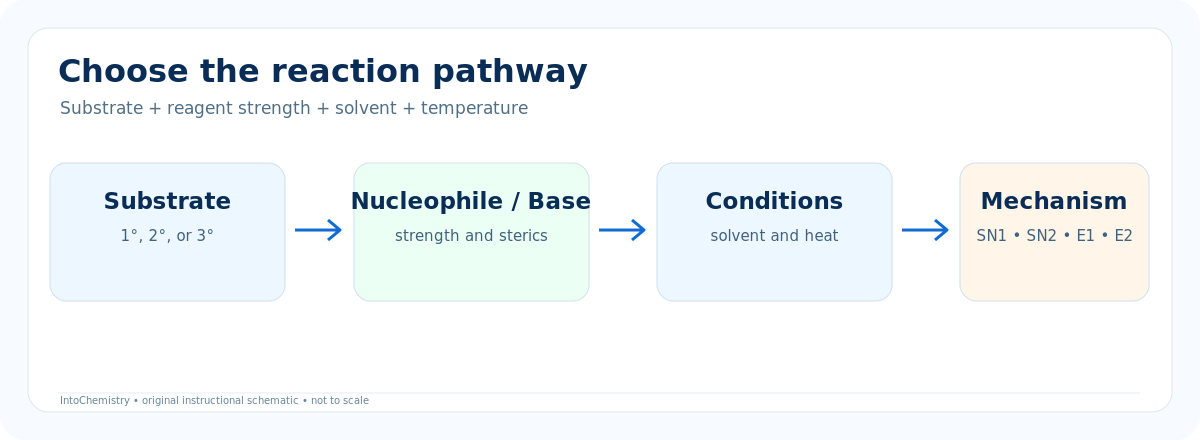
Evaluate substrate class, nucleophile, solvent, and temperature before selecting a mechanism.
1. Understand the Concept
One clue never determines a mechanism. Use a weighted decision: primary carbon plus an unhindered nucleophile in polar aprotic solvent suggests SN2; a hindered strong base favors E2; tertiary ionization in protic solvent can give competing SN1/E1 products.
Your goal: Evaluate substrate class, nucleophile, solvent, and temperature before selecting a mechanism.
2. Step-by-Step Exam Strategy
Methyl and primary substrates resist SN1; tertiary centers block normal SN2. Secondary substrates are particularly condition-dependent.
A strong bulky base typically favors E2. A good, weakly basic nucleophile can favor SN2 when steric access allows.
Polar aprotic solvents often help SN2. Polar protic solvents can stabilize ions; heat can increase elimination competition.
For E2 look for anti-periplanar beta H. For SN2 expect inversion of geometry. Rearrangements may occur only via carbocations.
3. Visual Reference
4. Worked Example
2-bromobutane + NaOEt, ethanol, heat
Expect E2 as a common major pathway with substitution competition; removing a β-hydrogen forms butenes. Zaitsev alkene usually predominates among allowed alkenes, with trans-2-butene generally favored over cis-2-butene.
5. Common Mistakes
- Treating every secondary substrate as SN2 regardless of base and heat.
- Assuming that all SN1 reactions produce a perfectly 50:50 racemate.
- Drawing E2 products without identifying an accessible anti β-H.
6. Practice & Reinforcement
Try the interactive questions below. In Practice mode, each answer includes an explanation. In Mock Exam mode, explanations appear after submitting the full set.
Interactive questions load when JavaScript is available. Download the printable study sets for offline review.