
Spectroscopy Challenge Lab
Combine IR, ¹H NMR, integration, splitting, and TLC evidence to identify plausible structures.
1. Understand the Concept
Spectra narrow the possibilities; they rarely prove a unique structure from one signal. Interpret functional-group evidence first, then use the proton environments, integration and coupling patterns to test a candidate.
Your goal: Combine IR, ¹H NMR, integration, splitting, and TLC evidence to identify plausible structures.
2. Step-by-Step Exam Strategy
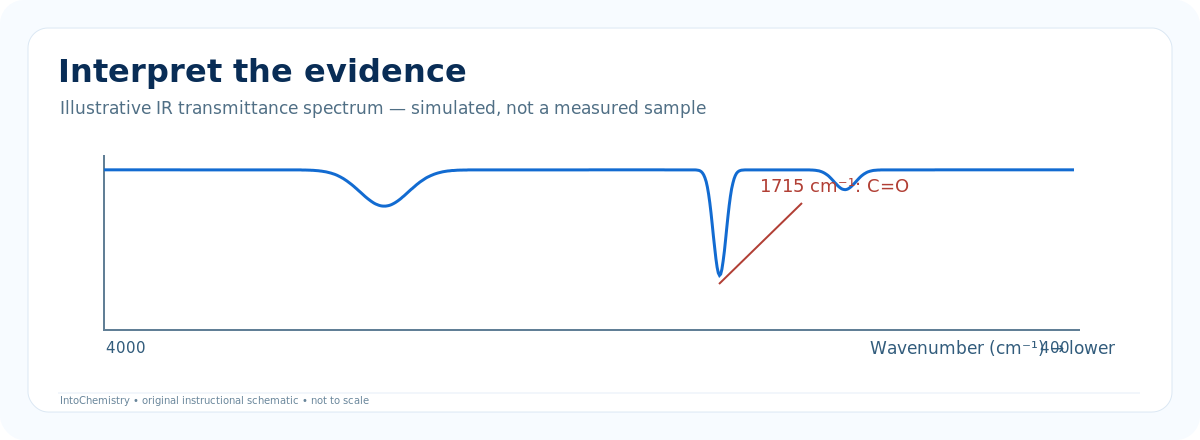
Use a strong C=O near 1715 cm⁻¹ or a broad O–H band only as evidence, considering conjugation and environment.
Different ¹H NMR groups reflect chemically non-equivalent protons; integration estimates relative count.
In simple first-order cases, n neighboring equivalent protons often give n+1 lines, but overlap and complex coupling exist.
Confirm atom count and degree of unsaturation; do not over-interpret one isolated peak.
3. Visual Reference
4. Worked Example
Acetone: IR + ¹H NMR
A saturated ketone C=O band appears near 1715 cm⁻¹ and one 6H singlet appears near 2.1 ppm for the equivalent methyl groups. This combined evidence supports propanone.
5. Common Mistakes
- Reading a peak near 3300 cm⁻¹ as definitely an alcohol without considering N–H or other groups.
- Treating a single chemical shift as a unique identifier.
- Ignoring signal integration or the full formula.
6. Practice & Reinforcement
Try the interactive questions below. In Practice mode, each answer includes an explanation. In Mock Exam mode, explanations appear after submitting the full set.
Interactive questions load when JavaScript is available. Download the printable study sets for offline review.