

Dimensional Analysis & Unit Conversions
Convert quantities by canceling units instead of memorizing isolated formulas.
Learn the concept, then practice it
Convert quantities by canceling units instead of memorizing isolated formulas. Start with the illustrated overview, follow the calculation, and try the questions.
given quantity × (desired unit / given unit) = converted quantity
Start with units
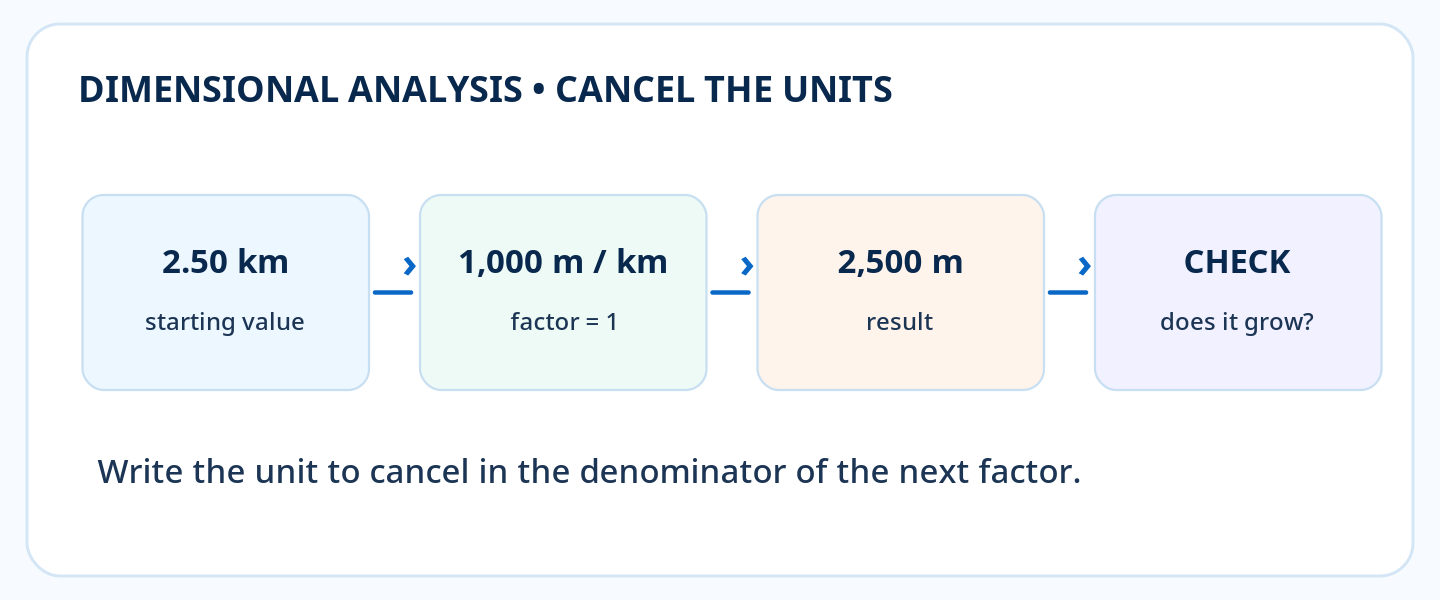
A conversion factor is a ratio equal to one. Write the given unit first; place that unit in the denominator of your factor so it cancels.
Multiply across the chain
Combine more than one factor when moving between metric prefixes, moles and mass, or length and volume. Unit cancellation should leave only the requested unit.
Check the answer
Ask if the size is reasonable. Converting from meters to centimeters should increase the numerical value by 100, not decrease it.
Convert 2.50 km to meters.
2.50 km × (1000 m / 1 km) = 2.50 × 10³ m. The km units cancel and three significant figures are retained.
Common mistake
A unit conversion changes the numerical value and the unit; it does not change the actual physical amount.
Practice with feedback
Select an answer to see a specific explanation. For more questions, open the General Chemistry Exam Center.
Loading local practice questions…
Keep learning
Try the full General Chemistry Exam Center for a mixed review, or select another topic in the Learning Center.
Open General Chemistry Exam Center →