
INTOCHEMISTRY / MEASUREMENT & MATTER
Density by Water Displacement
Turn two balance measurements and a change in water level into an evidence-based density calculation.
Find an object’s mass and volume by difference, calculate density with units, and identify circumstances where displacement is unreliable.
1. What are we measuring?
Density is the mass of a substance per unit volume. When a solid sinks and is fully submerged, the rise in liquid level gives the volume of that solid. Measure the dry sample’s mass by subtraction when a weighing container is used.
2. Set up the calculation
Sample mass = combined mass − empty container mass. Sample volume = final water reading − initial water reading. Density = sample mass ÷ displaced volume. Preserve units at every step.
3. Worked example
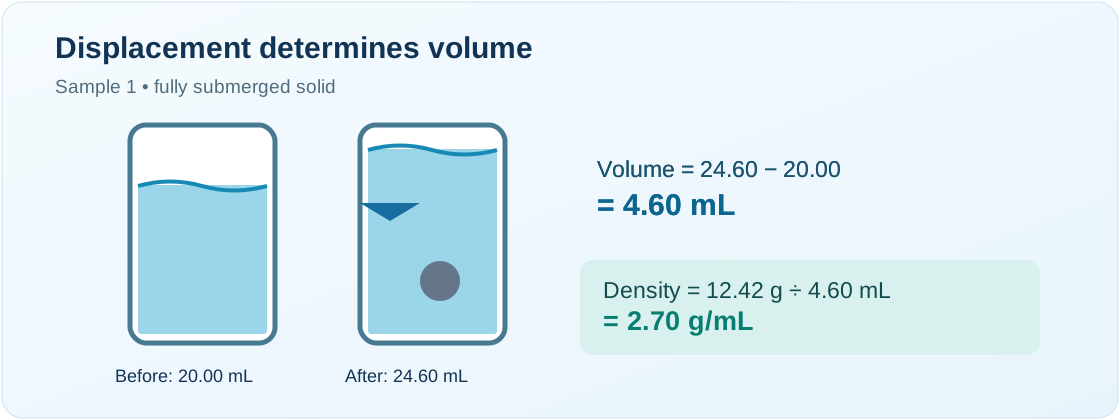
A dry solid and its container have a combined mass of 53.67 g; the empty container is 41.25 g. Water rises from 20.00 mL to 24.60 mL. The sample mass is 12.42 g and volume is 4.60 mL. Density = 12.42 ÷ 4.60 = 2.70 g/mL.
4. How to judge the result
Read the meniscus at eye level and record appropriate instrument precision. An attached air bubble increases displaced volume, making calculated density too low. Displacement is unsuitable without modification for samples that dissolve, absorb liquid, float, or chemically react with the liquid.
Quick concept check
An object has a mass of 10.80 g and displaces 4.00 mL. What is its density?
Show worked answer
10.80 g ÷ 4.00 mL = 2.70 g/mL.