
INTOCHEMISTRY / REACTION QUANTITIES
Theoretical and Percent Yield
Use limiting reactants, mole ratios, and recovered product mass to evaluate the yield of a synthesis.
Compute theoretical product mass from a balanced equation and compare it with the mass of pure, dry product actually recovered.
1. Theoretical versus actual
Theoretical yield is the calculated maximum amount of product from the limiting reagent, using a balanced equation. Actual yield is the amount of pure, dry product isolated experimentally. The two values answer different questions.
2. Calculate theoretical yield
Convert the limiting reactant mass to moles, apply the balanced mole ratio to obtain product moles, then multiply by the product molar mass. Do not use a 1:1 mole ratio unless the balanced coefficients support it.
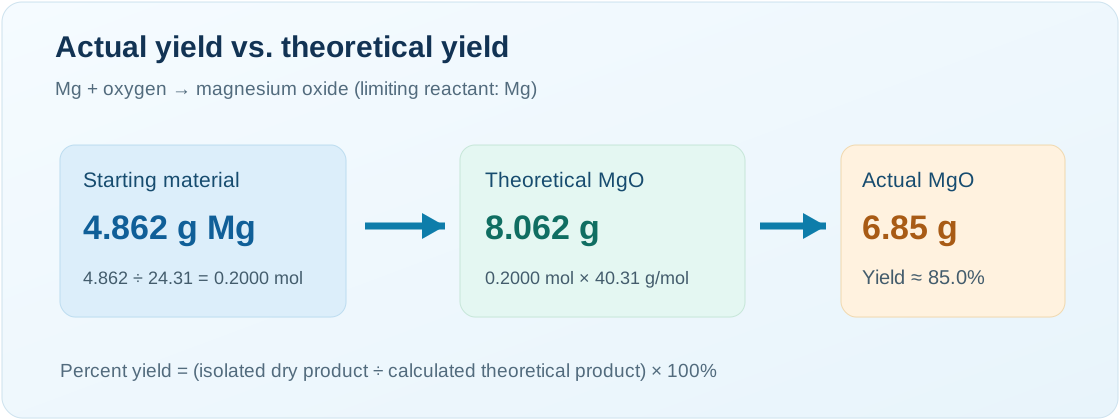
3. Worked example
For 2 Mg + O₂ → 2 MgO, 4.862 g Mg with excess O₂ is 4.862 ÷ 24.31 = 0.2000 mol Mg. The mole ratio Mg:MgO is 1:1, giving 0.2000 mol MgO × 40.31 g/mol = 8.062 g theoretical MgO. If 6.85 g is recovered, percent yield = (6.85 ÷ 8.062) × 100 ≈ 85.0%.
4. Interpret the result
Low yield may reflect incomplete reaction, side reactions, transfer losses, or product solubility. A reported yield above 100% should trigger checks for moisture, impurities, incorrect tare, or an inaccurate theoretical-yield calculation; it is not a pure dry product yield.
Quick concept check
A reaction has a 15.0 g theoretical yield and 12.0 g actual yield. What is percent yield?
Show worked answer
(12.0 ÷ 15.0) × 100 = 80.0%.