

pH, pOH & Strong Acids/Bases
Use logarithms to compare acidities and calculate pH for common strong electrolytes.
Learn the concept, then practice it
Use logarithms to compare acidities and calculate pH for common strong electrolytes. Start with the illustrated overview, follow the calculation, and try the questions.
pH = −log₁₀[H₃O⁺]; at 25 °C, pH + pOH = 14.00
Understand the scale
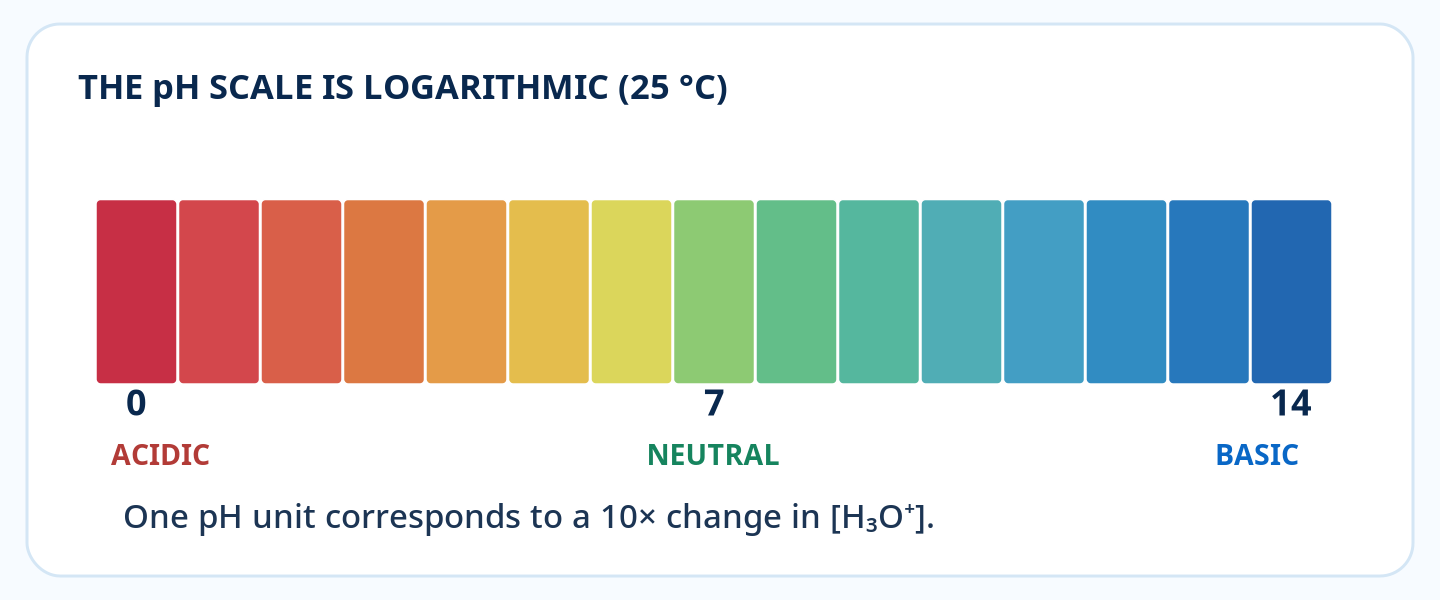
A difference of one pH unit corresponds to a tenfold change in hydronium concentration; smaller pH means larger [H₃O⁺].
Know the assumptions
For dilute strong monoprotic acids such as HCl, dissociation is essentially complete. The simple pH = −log C approximation neglects activity corrections and water autoionization.
Use pOH appropriately
At 25 °C, Kw ≈ 1.0 × 10⁻¹⁴ and pH + pOH = 14.00; this sum is temperature dependent.
What is the pH of 0.0010 M HCl at 25 °C?
[H₃O⁺] ≈ 1.0 × 10⁻³ M, so pH = −log₁₀(1.0 × 10⁻³) = 3.00.
Common mistake
Do not assume that pH + pOH = 14 at every temperature; 14.00 is the standard classroom approximation at 25 °C.
Practice with feedback
Select an answer to see a specific explanation. For more questions, open the General Chemistry Exam Center.
Loading local practice questions…
Loading educational calculator…
Keep learning
Try the full General Chemistry Exam Center for a mixed review, or select another topic in the Learning Center.
Open General Chemistry Exam Center →