

Why can you spend six hours studying chemistry the night before an exam, feel ready, and then struggle to explain the same material a week later? One reason is that knowing something looks familiar is not the same as retrieving it independently. Research generally favors spaced practice and practice testing for lasting learning, whereas cramming emphasizes immediate familiarity. [1]
1. What really happens when you cram?
Imagine a student rereading a chapter on substitution and elimination three times. By the third pass, familiar SN1 and SN2 examples appear easy. But a new question changes the substrate, reagent and solvent. The student must decide which mechanism applies rather than merely recognize a previously seen answer.
Massed practice concentrates repeated study within a short interval. Distributed practice separates learning episodes over time. In a broad review, Dunlosky and colleagues judged distributed practice and practice testing especially useful among popular study techniques. That finding does not mean every cramming session is worthless; it means immediate confidence is not a reliable stand-in for long-term retention. [1]
2. What does memory science actually tell us?
Encoding is the processing of information during learning. Consolidation describes changes that help stabilize memory over time. Retrieval is the act of reconstructing what you know when prompted. The hippocampus plays an important role in forming many new declarative memories, while longer-term representations involve distributed networks. Synaptic plasticity contributes to learning, but no simple study method can be described as switching on a particular neurotransmitter to guarantee better grades.
In chemistry, retrieving knowledge means drawing a Lewis structure from a formula, explaining why an acid–base equilibrium favors one direction, or describing electron flow in an unfamiliar organic mechanism. These activities reveal more than passive recognition.
3. The forgetting curve is not a fixed percentage
Hermann Ebbinghaus’s pioneering work helped establish that recall often declines over time. However, common graphics claiming that everyone forgets a fixed percentage within 24 hours oversimplify the evidence. The rate depends on material, prior knowledge, practice and testing conditions. A quantitative review of distributed practice examined 839 assessments from 317 experiments and found that the most useful interval between study sessions interacts with the time until the final test. [2]
Therefore, a student preparing for a quiz tomorrow may need different practice intervals than a student trying to remember chemical equilibrium for next semester.
4. Why spaced repetition helps
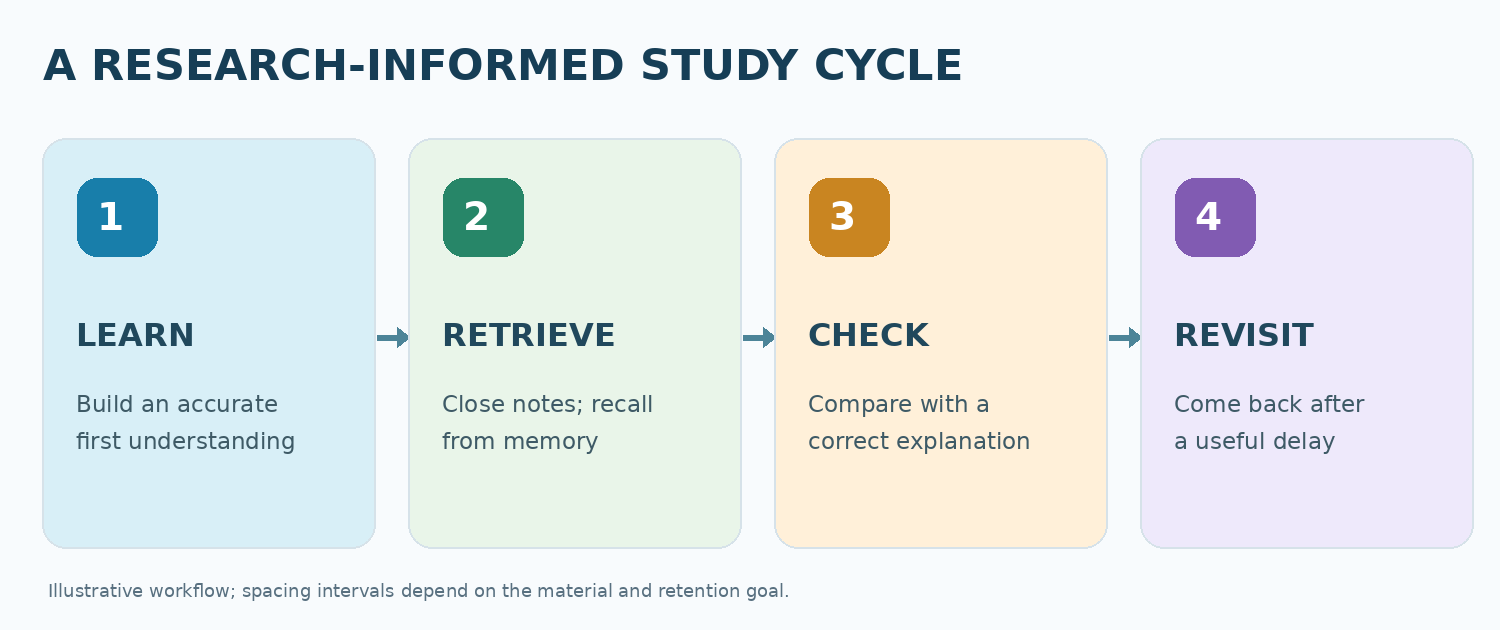
Spaced repetition means coming back to information after a delay, not repeatedly reviewing the same page in one sitting. You might learn molecular geometry on Monday, redraw structures on Wednesday, predict shapes for unfamiliar molecules on Friday, and include one geometry question in a cumulative review the following week.
The spacing effect is well documented, but there is no universally optimal 1–3–7-day schedule. Cepeda and colleagues’ quantitative synthesis found that the time between learning events and the intended retention interval jointly influence outcomes [2]. Start with manageable gaps and adjust them based on delayed performance. If you cannot recall an idea, revisit its prerequisites and try a shorter interval next time.
5. Retrieval practice: Why self-testing is different from rereading
Retrieval practice asks you to produce an answer before opening a book or viewing a worked solution. In experiments using educational passages, Roediger and Karpicke found that taking initial tests improved recall after delays of two days or one week relative to repeated studying, even when repeated studying could improve immediate recall. These results support the value of practice tests as learning activities, not simply as assessments [3].
Karpicke and Blunt also reported benefits of retrieval practice on questions involving understanding and inference from science texts under their experimental conditions [4]. An important practical step is to check what you retrieved. Feedback and targeted correction prevent you from repeatedly practicing an incorrect explanation.
Five chemistry retrieval activities
- Lewis structures: Draw nitrate, NO3−, from memory. Check valence electrons, formal charges and resonance.
- Stoichiometry: Solve a novel limiting-reactant problem with units before looking at the example.
- Acid–base chemistry: Explain why a buffer resists a change in pH when a small amount of strong acid is added.
- Organic chemistry: Decide whether an unfamiliar substrate and reagent combination more strongly favors substitution or elimination, and justify your answer.
- Equilibrium: Compare Q and K and predict the direction of the net reaction without referring to a decision chart.
Use a three-stage cycle: attempt → check → repair. An answer you guessed correctly should still be reviewed if the reasoning was uncertain.
6. Why rereading and highlighting can feel deceptively effective
When sentences look familiar, you may experience a sense of fluency. That feeling is not the same as independently explaining a concept. Highlighting can organize a chapter and rereading can repair an incomplete understanding, but a major review gave both lower overall utility ratings than spaced practice and practice testing [1].
After reading about VSEPR theory, close the lesson and answer: Why does ammonia have a trigonal-pyramidal molecular geometry rather than trigonal planar? Explaining the central lone pair, electron groups and distinction between electron-domain and molecular geometry is a more informative check than recognizing a diagram.
7. Interleaving: Practice selecting the right model
Blocked practice puts similar questions together. Interleaving mixes different types, forcing you to determine which concept or procedure applies. In experiments with mathematics problems, Rohrer and Taylor observed better performance on delayed tests under spaced and mixed-practice conditions [5]. This finding does not require students to mix brand-new concepts before they understand the basics.
For chemistry, learn one mechanism carefully first, then mix SN1, SN2, E1 and E2 questions so you must judge the substrate, leaving group, nucleophile/base, solvent and temperature. Or alternate gas-law, dilution and stoichiometry problems, with no chapter title revealing which relationship to use.
8. A realistic seven-day chemistry study plan
The following is a flexible example for students with approximately 30–60 minutes available per day. It is a planning aid, not a scientifically proven optimal set of intervals.
| Day | Activity | Purpose |
|---|---|---|
| 1 | Learn key concepts; complete worked examples and a short recall attempt. | Initial understanding |
| 2 | Recall Day 1 material with notes closed; correct mistakes. | Retrieval and feedback |
| 3 | Start a second topic and briefly revisit Day 1. | Introduce spacing |
| 4 | Solve mixed problems on the two topics. | Interleaving and transfer |
| 5 | Take a short quiz without notes; identify uncertain answers. | Diagnose weak areas |
| 6 | Study the errors and solve new versions of missed problems. | Targeted correction |
| 7 | Complete a cumulative self-assessment and review the explanations. | Check delayed retention |
For planning daily study time, see How Many Hours Should You Study Chemistry?. For a complementary mnemonic strategy, explore The Memory Palace Technique for Chemistry. Memory aids can support recall but are not substitutes for solving unfamiliar chemistry problems.
9. What if your chemistry exam is tomorrow?
You cannot recreate a week of distributed practice overnight. Still, you can make the remaining time productive: identify essential learning objectives, solve representative questions without notes, compare explanations with reliable sources, correct mistakes, and reserve a reasonable opportunity to sleep rather than relying on an all-nighter.
For quantitative chemistry, prioritize dimensional analysis, scientific notation and basic algebra alongside topic-specific calculations. See our General Chemistry Math Readiness article to identify mathematics skills that often interrupt chemistry problem solving.
10. Four study myths: Test yourself
Choose an answer before expanding each explanation. These questions use standard HTML controls and require no account.
True or false: If an explanation feels familiar, I can definitely solve a new problem on it.
False. Familiarity is not a guarantee of independent retrieval or application. Try a novel problem.
True or false: If practice retrieval feels difficult, it must be failing.
False. Challenging practice can be useful, but if you cannot answer, use feedback and relearning rather than repeated guessing.
True or false: Everyone should use the same spacing schedule.
False. Effective spacing depends on the learning material, the person and the retention goal [2].
True or false: You should never reread a chemistry textbook.
False. Rereading can repair understanding; the problem is treating rereading as the only evidence of mastery.
Frequently asked questions
Do chemistry flashcards actually work?
They can help with names, formulas and definitions when you retrieve an answer before revealing it. Multistep calculations and mechanisms additionally require full problem-solving practice.
Can cramming still improve tomorrow’s exam performance?
Yes. The distinction is between immediate performance and long-term retention. It would be inaccurate to say cramming produces no learning.
Should I quiz myself even if I have not mastered the material?
Use a manageable cycle of learning, trying to recall, checking the answer and correcting misunderstandings. An unsuccessful attempt is useful only if it leads to better understanding rather than repeated misinformation.
References
- Dunlosky, J., Rawson, K. A., Marsh, E. J., Nathan, M. J., & Willingham, D. T. (2013). Improving students’ learning with effective learning techniques. Psychological Science in the Public Interest, 14(1), 4–58. DOI:10.1177/1529100612453266.
- Cepeda, N. J., Pashler, H., Vul, E., Wixted, J. T., & Rohrer, D. (2006). Distributed practice in verbal recall tasks: A review and quantitative synthesis. Psychological Bulletin, 132(3), 354–380. DOI:10.1037/0033-2909.132.3.354.
- Roediger, H. L., III, & Karpicke, J. D. (2006). Test-enhanced learning: Taking memory tests improves long-term retention. Psychological Science, 17(3), 249–255. DOI:10.1111/j.1467-9280.2006.01693.x.
- Karpicke, J. D., & Blunt, J. R. (2011). Retrieval practice produces more learning than elaborative studying with concept mapping. Science, 331(6018), 772–775. DOI:10.1126/science.1199327.
- Rohrer, D., & Taylor, K. (2007). The shuffling of mathematics problems improves learning. Instructional Science, 35, 481–498. DOI:10.1007/s11251-007-9015-8.
© 2026 IntoChemistry. Original educational explanations. Last scientifically reviewed November 2026.