
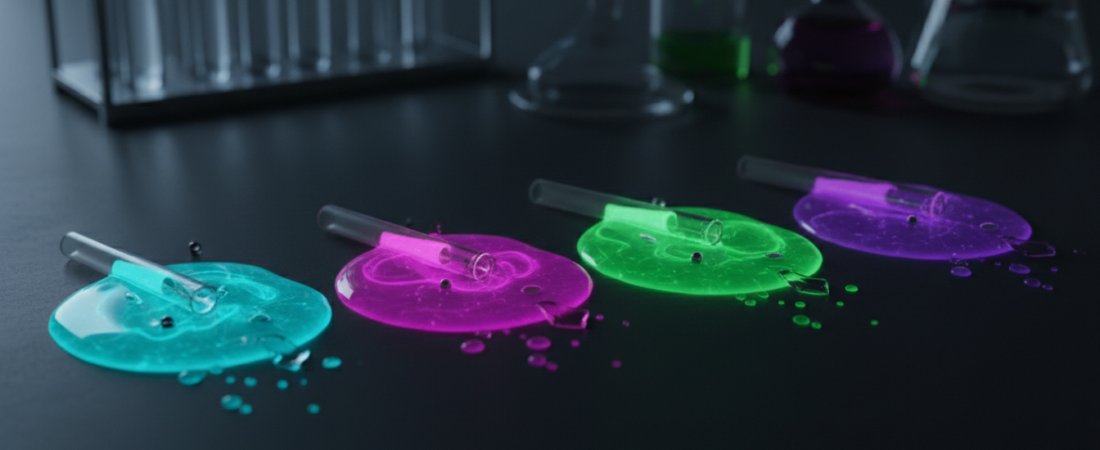
Snap. Shake. Glow. A brightly colored light appears inside a plastic tube, even though there are no batteries, wires, or flames. The explanation is a spectacular piece of chemistry called chemiluminescence: visible light produced by a chemical reaction.
Glow sticks also connect to one of the most useful ideas in chemistry—the rate of a chemical reaction. Why does a warm glow stick shine brighter but burn out sooner? Why are green and blue glow sticks different? And what do fireflies have in common with forensic laboratories?
What Is Inside a Glow Stick?
A typical commercial glow stick contains two solutions separated by a small, fragile inner vial. One solution commonly includes a fluorescent dye and an oxalate ester. The other contains hydrogen peroxide. The exact ingredients and additives vary among manufacturers.
When you bend the tube, the inner vial breaks. Mixing starts an oxidation reaction that produces an energy-rich intermediate; subsequent steps transfer chemical energy to a fluorescent dye. The dye reaches an electronically excited state and releases light as it returns to a lower-energy state.
The key idea: The energy comes from the chemical reaction, but the light’s color depends mainly on the fluorescent dye. No chemical reaction needs to make a substance hot enough to glow like a light-bulb filament.
Why Do Glow Sticks Come in Different Colors?
Different fluorescent dyes emit different wavelengths of light because their electronic energy levels differ. When a dye molecule returns from an excited state, it can release a photon with energy described by E = hc/λ, where h is Planck’s constant, c is the speed of light, and λ is wavelength.
A shorter wavelength corresponds to greater photon energy. That’s why blue and violet photons carry more energy than red photons. The dye controls which electronic transitions are available, so manufacturers can tune the glow color.
Why Does Temperature Change the Brightness?
A warmer glow stick usually reacts faster. More light-producing events occur per second, creating a brighter initial glow. But the reactants are also consumed faster, so the glow generally fades sooner. Cooling the stick usually does the opposite: lower brightness and longer glow duration.
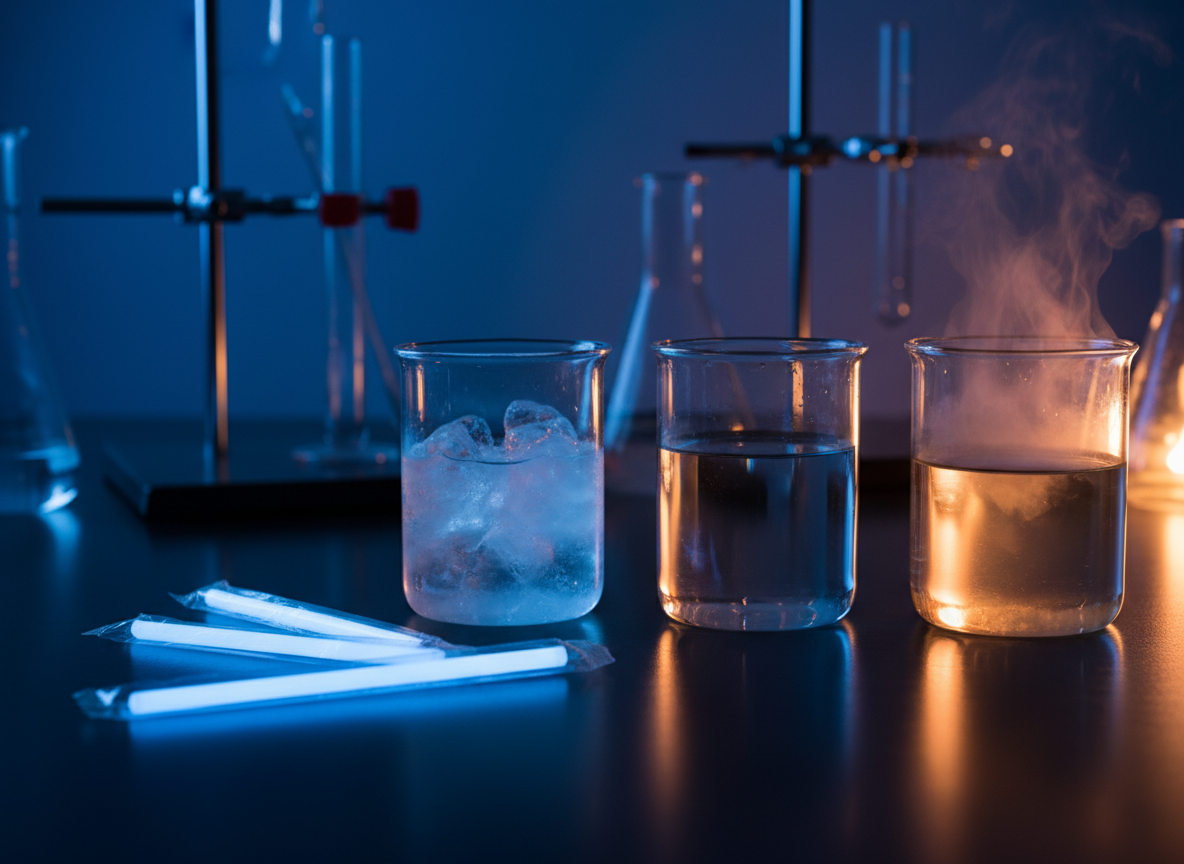
This is a real-world connection to chemical kinetics. The relationship is not simply “hot equals more light overall”; what you observe is a change in the rate at which photons are emitted. Compare like-for-like glow sticks under similar lighting conditions.
Try a Safe Glow-Stick Investigation
You can explore the effect of temperature with intact commercial glow sticks. Follow the product instructions and use a method appropriate for your setting. The American Chemical Society’s Slow the Glow activity provides a structured example.
- Activate two identical glow sticks and record the starting time.
- Keep one at room temperature and another in cool water, following product safety instructions.
- Observe both after equal time intervals under the same lighting conditions.
- Record a qualitative brightness scale, or photograph both with fixed camera exposure settings.
- Predict which stick will remain visibly glowing longer and compare that prediction with your data.
Safety: Keep the glow sticks sealed. Do not open, heat excessively, microwave, or use boiling water with them. Dispose of them according to their packaging and local guidance.
Is a Firefly’s Light the Same Chemistry?
Fireflies produce bioluminescence, a light-producing reaction that occurs in living organisms. Their chemistry uses a different system involving the substrate luciferin, the enzyme luciferase, ATP, and oxygen. The reaction generates an excited product that emits light.
The comparison is useful because the systems are different yet share a fundamental principle: chemical energy leads to electronic excitation, and light is emitted when an excited state relaxes. In fireflies, flashes can serve as signals for communication and mate recognition.
What Does Luminol Reveal at a Crime Scene?
Luminol is a separate chemiluminescent compound that can emit blue light when oxidized under suitable conditions. Forensic investigators may use it to screen for traces consistent with blood, because certain components of blood can help catalyze the reaction.
However, a positive luminol glow is not proof of blood. Some cleaners, metals, and other substances can produce a positive response. Confirmatory forensic testing and contextual evidence are necessary.
A Glow Stick Connects Five Important Chemistry Concepts
- Oxidation-reduction chemistry: the reaction that supplies energy.
- Reaction kinetics: temperature changes how quickly the light-producing chemistry proceeds.
- Electronic structure: excited dye molecules have higher-energy states.
- Electromagnetic radiation: light color is related to photon energy and wavelength.
- Analytical chemistry: the importance of controls and false positives in chemical detection.
A glow stick is a miniature reaction-kinetics experiment that happens to be beautiful.
Questions to Test Your Understanding
1. If you put an activated glow stick in cold water and its brightness decreases, does that prove the reaction has stopped? Explain. 2. Would a fluorescent green dye necessarily produce green light without an energy source? 3. Why must a luminol screening result be followed by other evidence?
Explore More Real Chemistry
Read Chemical & Engineering News on glow-stick chemistry and the ACS’s classroom activity. If you enjoy interactive investigations, explore our step-by-step stoichiometry guide and return to IntoChemistry for more explanations and study tools.
Scientific references and further reading
- American Chemical Society, Chemistry That Glows — background on chemiluminescence and related reactions.
- Journal of Chemical Education (1999), The Effects of Temperature on Lightsticks, DOI:10.1021/ed076p40A — reaction mechanism and temperature demonstration.
The discussion on this page is an independent educational explanation; the linked resources remain copyrighted by their respective owners. Do not open glow sticks or handle their contents without an approved activity protocol.