
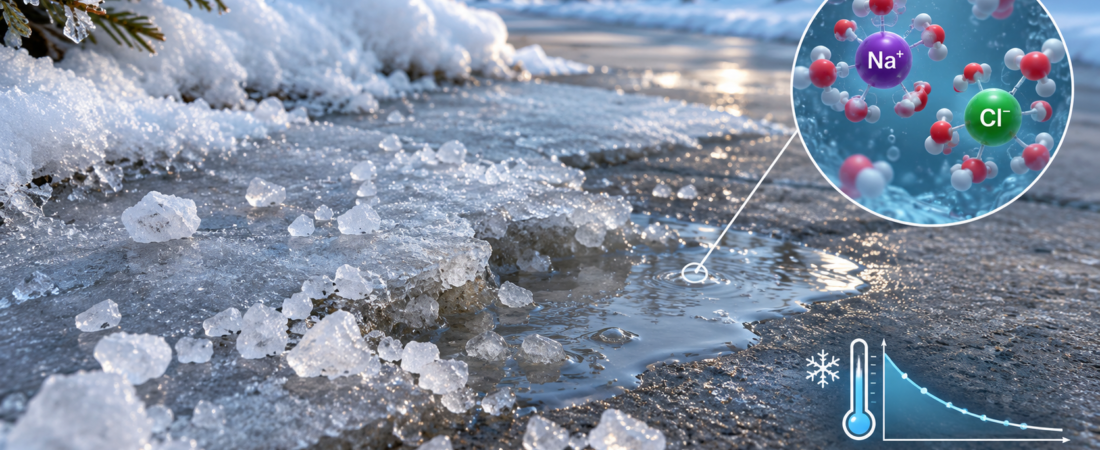
Why does a sidewalk treated with salt turn wet while an untreated sidewalk stays icy? The answer connects something familiar from winter weather to chemical potential, solutions, and phase equilibria. Salt does not simply “heat up” the ice. It changes the conditions at which liquid water and solid ice can coexist—and its effect has limits.
In this guide, we will follow a grain of road salt from a frozen sidewalk into a liquid brine, calculate a freezing-point change, compare sodium chloride with calcium chloride, and explain why real roads are more complicated than a textbook equation.
1. Salt needs liquid water to begin working
Most road salt is sodium chloride, NaCl. Even an apparently frozen surface can have small amounts of liquid water present. When NaCl encounters enough water, it dissolves and forms a brine containing sodium and chloride ions:
Original process diagram — from ice to brine
Frozen H2O with a little available liquid moisture
NaCl(s) → Na+(aq) + Cl−(aq)
The lower freezing point allows more ice to melt at a suitable temperature
As brine forms, ice can melt into it when temperature and concentration permit. Melting requires energy—the latent heat of fusion. The roadway may supply heat from pavement, sunlight, the surrounding air, or other sources. The Iowa Department of Transportation emphasizes that dry chemicals must first form brine and that cold conditions reduce how efficiently salt removes ice.
2. What freezing-point depression actually means
Pure water at ordinary atmospheric pressure freezes near 0 °C (32 °F). Dissolving a solute generally lowers the temperature at which solid ice and liquid solution are in equilibrium. This effect is called freezing-point depression, a colligative property. In dilute, approximately ideal solutions, what matters most is the number of dissolved particles—not whether the particles are large or small.
NaCl separates into ions when it dissolves. In a simplified picture, one formula unit produces two dissolved particles:
NaCl(s) → Na+(aq) + Cl−(aq)
More dissolved particles influence water’s chemical potential and shift the ice–solution equilibrium. The phrase “salt breaks the hydrogen bonds in ice” is an oversimplification: ice melting is an equilibrium and energy-transfer process, not a claim that individual salt ions pry apart an ice crystal all by themselves.
3. Calculate a freezing-point change
For a dilute solution, the usual introductory-chemistry approximation is:
ΔTf ≈ iKfm
i = effective van ’t Hoff factor; Kf = freezing-point-depression constant; m = molality (mol solute per kg solvent).
For water, Kf = 1.86 °C·kg/mol. In the ideal-dissociation approximation, i ≈ 2 for NaCl. OpenStax Chemistry provides the water constant and explains the concentration dependence of colligative properties.
Worked example: 29.22 g NaCl in 1.00 kg water
- Convert mass to moles. 29.22 g ÷ 58.44 g/mol = 0.5000 mol NaCl.
- Calculate molality. 0.5000 mol ÷ 1.00 kg = 0.500 m.
- Calculate the idealized depression. ΔTf ≈ (2)(1.86 °C·kg/mol)(0.500 mol/kg) = 1.86 °C.
- Interpret the result. The estimated freezing point is 0.00 − 1.86 = −1.86 °C (about 28.7 °F).
Important limitation: Ion pairing, activity effects, and real-world concentration changes make i different from exactly 2. This equation works as a dilute-solution model; it should not be extrapolated to highly concentrated road brines near their eutectic points.
4. Does road salt stop working at 15 °F or −6 °F?
Both numbers appear in discussions of road salt, but they describe different concepts. The distinction matters:
| Temperature | Meaning | Practical interpretation |
|---|---|---|
| 32 °F (0 °C) | Freezing point of pure water at standard pressure | Untreated water is at the familiar freezing/melting boundary. |
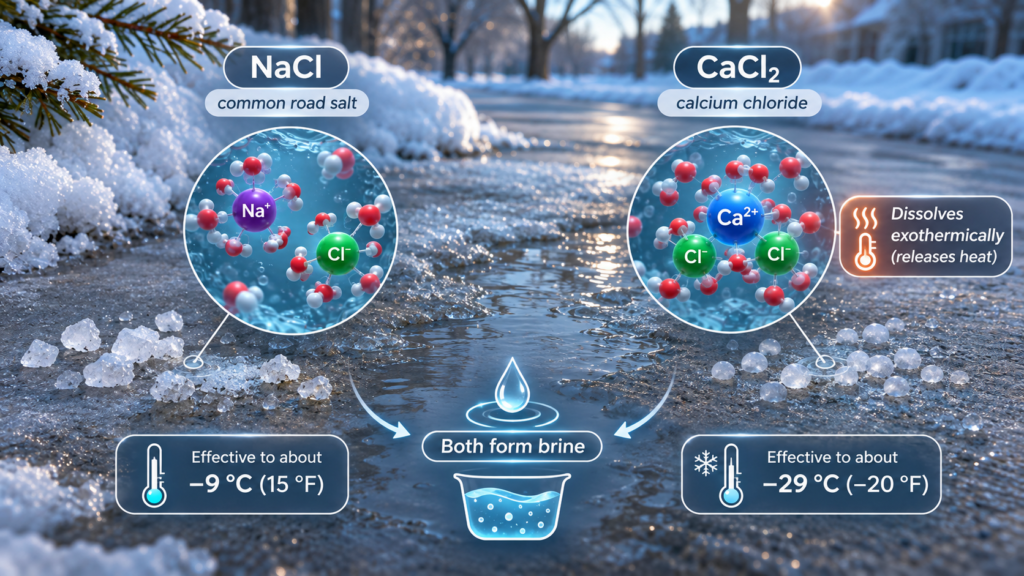
| About 15 °F (−9 °C) | A commonly cited practical lower-temperature range for routine NaCl deicing | Salt may act too slowly or need too much material to be an efficient treatment; conditions matter. |
| About −6 °F (−21 °C) | Eutectic temperature of the NaCl–water system, near 23% NaCl by mass | A phase-equilibrium limit for a particular brine composition—not a guarantee that dry salt will melt road ice efficiently there. |
The Federal Highway Administration’s anti-icing guidance documents both the approximately −21 °C eutectic point and the much warmer practical operating limits agencies often use. The University of Minnesota’s Smart Winter Salt guide similarly notes that ordinary rock salt performs best above roughly 15 °F.
At lower temperatures, brine forms less readily, melting proceeds more slowly, and the amount of salt needed can become impractical. A theoretical liquid-phase boundary tells you what compositions could remain liquid at equilibrium; it does not tell you how fast a grain of salt on a frozen road will work.
5. Why do some crews use calcium chloride?
Calcium chloride, CaCl2, behaves differently from NaCl. In a simple dissociation picture, one formula unit yields three ions:
CaCl2(s) → Ca2+(aq) + 2Cl−(aq)
Calcium chloride is hygroscopic and its dissolving process is exothermic under common deicing conditions, which can help liquid brine form. Its water–salt phase diagram also extends to substantially lower eutectic temperatures than the NaCl–water system. However, performance depends on the surface temperature, product form, concentration, cost, and field conditions. “CaCl2 works at −60 °F” is therefore not an appropriate blanket promise for a sidewalk or highway. See the FHWA comparison of NaCl and CaCl2.
6. More salt is not always a better answer
Suppose two nearby sidewalks receive identical salt applications. One pavement is near 25 °F; the other is near 0 °F. In the colder location, the same mass of salt generally has a harder job: brine formation slows and less melting occurs during the same period. The final result depends on the actual pavement temperature, the initial ice thickness, application timing, and the availability of moisture and heat.
Because liquid brine is the active phase, pre-wetted salt or properly formulated anti-icing brine can begin acting sooner than dry crystals in some situations. Shoveling or plowing away bulk snow first can reduce how much chemical is needed. For actual treatment, follow product labels and local maintenance guidance; do not assume any deicer is safe for every concrete surface, plant, pet, or metal.
7. The environmental chemistry of road salt
When melted snow drains away, the Na+ and Cl− do not simply disappear. Chloride can travel with runoff and groundwater into streams and lakes. Unlike some organic contaminants, chloride does not biodegrade into a harmless compound. A U.S. Geological Survey investigation found winter chloride concentrations above EPA aquatic-life criteria in numerous monitored northern streams.
This creates a real engineering tradeoff: preventing slips and crashes is essential, but excessive salt use can increase water-quality impacts and corrosion. Smart applications combine mechanical removal, temperature-aware decisions, targeted deicing, and traction materials where appropriate.
8. Try the chemistry yourself
Practice problem: A student dissolves 11.69 g of NaCl in 0.500 kg of water. Assuming ideal ion separation, calculate the molality and approximate freezing point. Use a NaCl molar mass of 58.44 g/mol and Kf = 1.86 °C·kg/mol.
Show worked answer
Moles NaCl = 11.69 ÷ 58.44 = 0.2000 mol. Molality = 0.2000 ÷ 0.500 = 0.400 m. Thus ΔTf ≈ (2)(1.86)(0.400) = 1.49 °C; the idealized freezing point is approximately −1.49 °C.
Frequently asked questions
Does salt melt ice by releasing heat?
Not primarily. Sodium chloride changes the ice–water equilibrium by forming a solution; energy to melt the ice must still come from the surroundings. Calcium chloride can release heat as it dissolves, but that is a separate, material-specific effect.
Can saltwater freeze?
Yes. Every real saltwater mixture has phase behavior that depends on its concentration and temperature. Ordinary road brine is not “unfreezable.”
Is the air temperature or pavement temperature more important?
For deicing, pavement temperature is especially relevant because it is the temperature experienced by the ice–brine interface. Air temperature and sunshine affect how that surface warms or cools.
Keep learning with IntoChemistry
Build on this real-world example with General Chemistry II: Colligative Properties and Vapor Pressure, the Chemistry Math Review hub, and free chemistry worksheets.
Sources and further reading
- Iowa Department of Transportation. Roadway Deicing. Explanation of brine formation, pavement heat, and temperature effects.
- Federal Highway Administration. Recommended Anti-Icing Practices: Sodium Chloride and Calcium Chloride (FHWA-RD-95-202, 1996). Eutectic phase behavior and field-temperature limitations.
- OpenStax. Chemistry: Atoms First 2e, §11.4, Colligative Properties. Freezing-point depression theory and the Kf of water.
- University of Minnesota LTAP. Smart Winter Salt: What Is Salt and How Does It Work?. Practical homeowner applications and temperature caveats.
- U.S. Geological Survey. Evaluating Chloride Trends Due to Road-Salt Use and Its Impacts on Water Quality and Aquatic Organisms. Environmental evidence.
Editorial note: Original explanatory text, scenario, process diagram, and calculations prepared for IntoChemistry. External references substantiate the scientific principles; the numerical practice problem is a constructed teaching example, not a measurement from a roadway. © 2026 IntoChemistry LLC.