
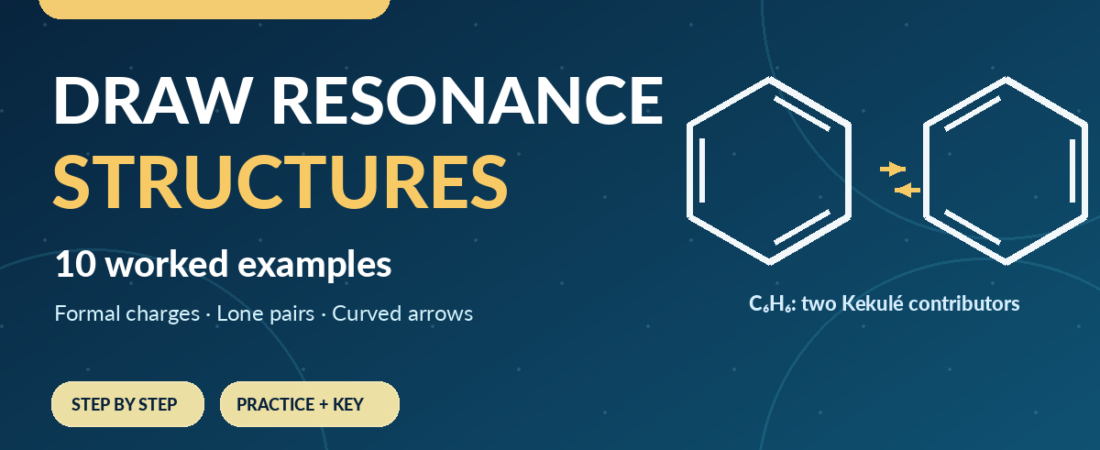
Want to know how to draw resonance structures correctly? This visual guide walks through formal charges, curly-arrow electron movement, ten worked chemical examples, and exam-style practice—with special care to distinguish resonance from chemical reactions.
What moves—and what never moves—in resonance.
Color-coded atoms, bond orders, charges, and lone pairs.
Eight self-check questions with answers you can reveal.
What are resonance structures in chemistry?
A single Lewis structure cannot always communicate the actual distribution of electrons in a molecule or polyatomic ion. When electrons can be delocalized across overlapping orbitals, we often draw two or more resonance contributors (also called resonance forms or canonical structures). The structures preserve all nuclei and sigma-bond connections, but the placement of some multiple bonds, lone pairs, and formal charges can differ. IUPAC Gold Book.
The double-headed resonance arrow (↔) connects electron-bookkeeping drawings of one species. It does not mean two molecules are rapidly interconverting or that there is a chemical equilibrium. The observed structure is better described by a resonance hybrid, with an electron distribution not fully represented by one diagram.
CH₂=CH–CH₂⁺ ↔ ⁺CH₂–CH=CH₂
Only π electrons and the location of formal charge differ.CH₃–C(=O)–CH₃ ⇌ CH₂=C(OH)–CH₃
Keto–enol tautomerism changes H location and σ bonding.How to draw resonance structures: a reliable five-step method
- Draw a valid starting Lewis structure. Count valence electrons, include the overall ionic charge, and place all atoms and lone pairs.
- Find a conjugated region. Look for a lone pair or negative charge next to a π bond, a π bond next to an empty p orbital/positive charge, or alternating π bonds around a conjugated system.
- Push electrons, not atoms. Use a full-headed curved arrow starting at a lone pair or bond and ending at the bond or atom receiving that electron pair. When forming a π bond at a second-row atom, another π bond often must break to maintain the octet.
- Redraw the new contributor. Keep the same atoms, hydrogens, and sigma bonds. Change only the indicated bond orders, lone pairs, and formal charges.
- Audit the result. Verify each atom’s valence, the sum of formal charges, and the unchanged molecular formula. Repeat until you have the distinct valid contributors relevant to the system.
Formal charge formula and worked calculation
For a singly bonded O⁻ with three lone pairs, formal charge = 6 − 6 − (2/2) = −1. For a doubly bonded oxygen with two lone pairs, formal charge = 6 − 4 − (4/2) = 0. For the central N⁺ in nitrate with one N=O and two N–O bonds, formal charge = 5 − 0 − (8/2) = +1. OpenStax: Formal Charges and Resonance.
10 worked resonance structures with formal charges and electron movement
These examples progress from common general-chemistry ions to organic carbocations, carbanions, aromaticity, amides, and enolates. For every problem, ask three questions: What electrons move? Do the formal charges add up? Which contributors are equivalent or more important?
Oxygen-containing molecule
Ozone (O₃)
One terminal oxygen has a single bond and formal charge −1; the central oxygen has a +1 formal charge and one lone pair. In the second form, the terminal O⁻ lone pair makes the new π bond while the original π bond becomes a lone pair on the opposite terminal oxygen. The central atom remains oxygen, and the molecule remains neutral overall. The two equivalent contributors help describe the two comparable O–O bonds.
Curved-arrow reasoning: Curved arrows: terminal O⁻ lone pair → adjacent O–O bond; original O=O π bond → its terminal oxygen.
Complete the Lewis structure: For each contributor: single-bonded O⁻ has three lone pairs; double-bonded terminal O has two; central O⁺ has one.
Polyatomic ion
Nitrite ion (NO₂⁻)
Nitrite has 18 valence electrons (5 + 2 × 6 + 1). Nitrogen retains one lone pair and has one N–O single bond and one N=O double bond in each form. The singly bonded oxygen is −1, while N and the double-bonded oxygen have zero formal charge. Swapping which oxygen has the double bond gives two equivalent contributors; the ion’s overall charge stays −1.
Curved-arrow reasoning: A lone pair on the single-bonded oxygen forms N=O as the other N=O π pair moves onto the other oxygen.
Complete the Lewis structure: N: one lone pair; singly bonded O⁻: three; doubly bonded O: two.
Polyatomic ion
Nitrate ion (NO₃⁻)
The nitrate ion has 24 valence electrons. Each valid octet-respecting contributor gives central N a +1 formal charge, two singly bonded O atoms −1 each, and the double-bonded O a formal charge of zero. The sum is +1 −1 −1 = −1. The double bond can be assigned to any of the three equivalent oxygens, so draw three equivalent major contributors. Never draw five bonds around nitrogen: second-row N cannot exceed an octet.
Curved-arrow reasoning: Move an O⁻ lone pair into a new N–O π bond while shifting the previous N=O π pair onto that oxygen.
Complete the Lewis structure: Double-bonded O: two lone pairs; each O⁻: three; central N⁺: none.
Polyatomic ion
Carbonate ion (CO₃²⁻)
The carbonate ion has 24 valence electrons. In each form, carbon has one C=O bond and two C–O⁻ bonds and a complete octet. Both singly bonded oxygens carry −1; carbon and the double-bonded oxygen are neutral. The charge total is −2. Move the π bond among the three oxygens to obtain three equivalent contributors, which predict three equivalent C–O bonds in the resonance hybrid.
Curved-arrow reasoning: An O⁻ lone pair makes a π bond to C; the existing C=O π electrons go to the oxygen losing the double bond.
Complete the Lewis structure: C: no lone pairs; C=O oxygen: two; each O⁻: three.
Carboxylate resonance
Acetate ion (CH₃COO⁻)
Start with CH₃–C(=O)–O⁻. A lone pair on O⁻ forms a second C–O π bond while the carbonyl π pair shifts onto the other oxygen. The negative charge is delocalized over the two oxygen atoms; the carbon skeleton and hydrogens do not move. These are equivalent contributors in an unsubstituted carboxylate group. This helps explain why carboxylate C–O bond lengths are nearly equal and why carboxylate ions are stabilized relative to a localized negative charge.
Curved-arrow reasoning: The O⁻ lone pair forms C=O while the original C=O π pair becomes a lone pair on the other oxygen.
Complete the Lewis structure: O⁻ has three lone pairs in each contributor; C=O oxygen has two.
Delocalized carbocation
Allyl cation (C₃H₅⁺)
The allyl cation has a positively charged terminal carbon next to a π bond. Move the π electrons toward the adjacent C–C bond to make a new π bond, moving the formal positive charge to the opposite terminal carbon. The two forms are equivalent, and the positive charge is spread across the terminal positions of the allylic system. Do not push an arrow starting at a positive charge: arrows start where electrons are.
Curved-arrow reasoning: One curved arrow from the existing C=C π bond into the adjacent C–C bond; do not move any atoms.
Complete the Lewis structure: The positively charged CH₂ center has an empty p orbital and no lone pair. Its six-electron configuration is allowed for a carbocation.
Delocalized carbanion
Allyl anion (C₃H₅⁻)
Here the terminal CH₂⁻ has a lone pair next to a double bond. Move the lone pair to form a new double bond; shift the existing π electrons onto the opposite terminal carbon. The negative formal charge is represented at either end in two equivalent forms. Both ends participate in a delocalized π system; no proton is transferred.
Curved-arrow reasoning: Carbanion lone pair → adjacent C–C bond; existing C=C π bond → opposite terminal carbon.
Complete the Lewis structure: The negatively charged terminal carbon has one lone pair. A terminal carbon shown as CH₂ with a double bond is neutral.
Aromatic resonance
Benzene (C₆H₆)
Two Kekulé forms show the three C=C bonds occupying alternating positions around benzene. Each vertex represents a CH unit; all atoms and the carbon ring stay in place. The π electrons are delocalized, making the six carbon–carbon bonds equivalent in the real aromatic molecule. Benzene is not constantly converting between two distinct species in an equilibrium. These drawings are two valid representations of the same aromatic system.
Curved-arrow reasoning: The π bonds are redistributed around the ring; use the resonance arrow, not a reaction equilibrium arrow.
Complete the Lewis structure: All six neutral ring carbons satisfy valence 4 when their implicit C–H bonds are counted.
Nitrogen lone-pair donation
Acetamide (CH₃CONH₂)
A lone pair on amide nitrogen is conjugated with the adjacent carbonyl. Donation of that lone pair into the C–N bond is paired with movement of the C=O π electrons onto oxygen. In this contributor, O is −1 and N is +1, with no octet violations. The neutral form is typically the larger contributor, but the charge-separated form explains partial C–N double-bond character, hindered rotation, and approximate planarity around amide nitrogen.
Curved-arrow reasoning: Nitrogen lone pair → C–N bond; carbonyl C=O π bond → oxygen. Two arrows operate together.
Complete the Lewis structure: Neutral NH₂ has one lone pair and three bonds; NH₂⁺ in the C=N form has four bonds and no lone pair. O⁻ has three lone pairs.
Oxygen versus carbon charge
Acetone enolate (C₃H₅O⁻)
Deprotonation of acetone at an α carbon produces an enolate. One contributor places the negative formal charge on the α-carbon (CH₂⁻) while retaining C=O. In the other, the α-carbon lone pair creates C=C and the carbonyl π pair moves to oxygen, giving O⁻. The oxygen-anion form is generally the more important contributor because oxygen better accommodates negative charge. Unlike keto–enol tautomerism, these resonance forms have identical atom and hydrogen positions.
Curved-arrow reasoning: α-Carbanion lone pair → Cα–Ccarbonyl bond; C=O π bond → oxygen.
Complete the Lewis structure: The carbanion contributor has one lone pair on CH₂⁻; the O⁻ contributor has three lone pairs on oxygen.
How do you decide which resonance contributor is major?
Not all valid resonance contributors contribute equally. For comparable structures, begin with these rules, but remember they are qualitative preferences rather than a universal numeric ranking:
- Favor complete octets on second-period atoms C, N, O, and F, except for known electron-deficient species such as carbocations.
- Minimize unnecessary formal charges and charge separation when other factors are comparable.
- Place negative formal charge on an atom better able to stabilize it, often the more electronegative atom; this helps explain the major oxygen-anion form of an enolate.
- Compare equivalent drawings carefully. If the atom arrangement is symmetric and the contributors are otherwise equivalent, they have equal importance; do not arbitrarily declare one major.
- Consider conjugation and aromaticity. A contributor that interrupts an otherwise favorable delocalized system may be minor.
| Species | How many highlighted contributors? | Key conclusion |
|---|---|---|
| O₃ and NO₂⁻ | 2 equivalent each | Comparable bond character on either side |
| NO₃⁻ and CO₃²⁻ | 3 equivalent each | Delocalized π bonding over three oxygens |
| Acetate | 2 equivalent | Negative charge distributed across two O atoms |
| Allyl cation / anion | 2 equivalent each | Formal charge can be represented at either terminal carbon |
| Benzene | 2 Kekulé forms shown | Equivalent aromatic C–C bonds in the real molecule |
| Acetamide | Neutral and charge-separated | Neutral form typically larger contributor; C–N partial double character |
| Acetone enolate | O⁻ and α-C⁻ | O⁻ contributor generally more important |
Seven resonance mistakes to avoid
- Moving an atom or hydrogen. This produces a different species or an isomer/tautomer, not a resonance form.
- Moving a σ bond. Ordinary resonance keeps the σ-bond skeleton fixed.
- Violating a C, N, or O octet. When a π bond forms next to a double bond, move the other π pair if necessary.
- Changing overall charge. A nitrate contributor must still sum to −1; carbonate must still sum to −2.
- Starting curved arrows at a positive charge. Start where the electron pair already exists.
- Calling resonance an equilibrium. ↔ is a representation arrow, not the forward/reverse reaction arrows.
- Assuming every contributor is equally important. An amide’s neutral and charge-separated forms are valid but not equivalent in weight.
Practice resonance structures before checking the answers
Cover the answer boxes, draw the complete Lewis structures with lone pairs, and write all relevant resonance forms. Only then reveal the explanations.
A. Formate, HCOO⁻
How many equivalent major contributors are there? Identify which oxygen has −1 in each drawing.
Reveal worked answer
Two equivalent contributors: H–C(=O)–O⁻ and H–C(–O⁻)=O, with the double bond and formal charge on opposite oxygens. The real carboxylate charge is delocalized.
B. Carbonate, CO₃²⁻
Draw all equivalent contributors; what is the formal charge on the carbon atom?
Reveal worked answer
Three equivalent contributors. Each has one C=O and two C–O⁻ bonds. Carbon has formal charge 0; total charge −2.
C. Ozone, O₃
Assign each atom’s formal charge in a valid octet-respecting contributor.
Reveal worked answer
Single-bonded terminal O is −1, central O is +1, double-bonded terminal O is 0; the second contributor swaps the terminal bond orders and −1 location.
D. Allyl cation, CH₂=CH–CH₂⁺
Draw the second contributor with one curved arrow. Where does the positive charge go?
Reveal worked answer
π electrons from CH₂=CH move into the adjacent CH–CH₂ bond. The second contributor is ⁺CH₂–CH=CH₂. The terminal positions share positive-charge character.
E. Acetamide, CH₃CONH₂
Show the charge-separated contributor and calculate the formal charges on O and N.
Reveal worked answer
CH₃–C(–O⁻)=NH₂⁺. Carbonyl oxygen becomes −1 with three lone pairs; nitrogen becomes +1 with four bonds and no lone pair.
F. Acetone enolate
Does the enolate’s O⁻ form or C⁻ form generally contribute more? How is this different from keto–enol tautomerism?
Reveal worked answer
The O⁻ contributor generally contributes more because negative charge is better accommodated on oxygen. Enolate resonance leaves H positions fixed; keto–enol tautomerism moves a proton and changes sigma bonding.
G. Nitrite, NO₂⁻
How many lone pairs belong to central N in either main contributor?
Reveal worked answer
One N lone pair. Each contributor has one N=O and one N–O⁻ bond, with N formal charge 0 and overall ion charge −1.
H. Validity check
Could O=N(=O)–O⁻ be used for nitrate with nitrogen in the center?
Reveal worked answer
No. With two N=O double bonds plus one N–O single bond, nitrogen has a bond-order sum of 5 (10 electrons around N), violating the octet rule for second-row nitrogen.
Frequently asked questions about resonance
How many resonance structures can a molecule have?
There is no universal count. Some examples have two obvious equivalent major forms (acetate); nitrate and carbonate have three equivalent major forms; more complex species may have additional minor valid contributors. Draw the distinct contributors that obey the relevant electron and valence rules.
Do resonance structures actually exist separately?
No. They are alternative representations of one electron distribution, not molecules rapidly flipping between the drawings. The physical species is a resonance hybrid.
Can you move hydrogen atoms while drawing resonance?
No. Proton movement changes atom connectivity and is not a resonance move. Keto–enol tautomerism is a different chemical process.
What is the difference between a curved arrow and a resonance arrow?
A curved arrow depicts movement of an electron pair during a mechanism or between electron-bookkeeping resonance drawings. A double-headed straight resonance arrow (↔) separates complete contributing Lewis structures.
Are major contributors the only valid resonance structures?
No. Minor contributors may be valid and useful for explaining reactivity or polarization. Their importance differs; use octets, charge separation, and electronegativity to compare them.
Why is the enolate oxygen contributor usually major?
Oxygen is more electronegative and generally stabilizes the negative formal charge better than carbon; IUPAC specifically identifies the oxygen-anion and carbon-anion contributors as unequal in the acetone enolate.
Do you have to draw lone pairs on resonance structures?
For Lewis-structure assignments and curved-arrow problems, yes: lone pairs determine electron sources and formal charges. The illustrations in this guide omit dot symbols only to keep labels readable; each example tells you the required lone-pair counts.
A quick study strategy and related IntoChemistry lessons
After reviewing a diagram, redraw it from memory with lone pairs and arrows, then compare it with the correct form. Revisit problems after a delay and use fresh molecules instead of repeating only identical drawings. For additional support, explore Lewis structures, formal charge, the interactive resonance lesson, organic functional groups, and free chemistry worksheets.
References and scientific accuracy
- International Union of Pure and Applied Chemistry. Resonance form, IUPAC Gold Book. Terminology, equivalence of representations, and the acetone enolate example.
- International Union of Pure and Applied Chemistry. Contributing structure, IUPAC Gold Book. Relative significance of contributing structures.
- OpenStax. Chemistry 2e, §7.4, Formal Charges and Resonance. Formal-charge method, Lewis structures, and resonance examples.
- OpenStax. Chemistry 2e, Chapter 7 exercises. Additional resonance practice.
Illustration note: All chemical diagrams on this page are original labeled vector drawings generated from explicitly defined atom positions, bond orders, formal charges, and molecular connectivities for this article. They are instructional Lewis diagrams—not measured molecular geometries—and paired purple dots now show lone pairs. The accompanying explanations provide a second check of atom valences and formal charges.