
Why can a 3D-printed plastic part tolerate one liquid yet soften, crack, swell or lose strength in another? The answer begins with polymer chemistry—but it also depends on solvent concentration, temperature, contact time, stress and how the part was manufactured. A part that looks unchanged after a short exposure may still have lost mechanical strength.
1. What is a polymer?
A polymer is a molecule containing many repeating structural units linked into long chains. Plastics may contain one principal polymer plus pigments, stabilizers, plasticizers, fillers or other components. Molecular weight, chain arrangement, crystallinity, processing history and additives influence how the final material behaves.
Some polymer regions are relatively ordered and crystalline; others are amorphous. Solvent penetration and chain mobility can differ between these regions. Another important concept is the glass-transition temperature, Tg, associated with increased segmental mobility in amorphous material. If absorbed solvent lowers the effective Tg, a part can become more flexible or lose stiffness without a single backbone bond being chemically cleaved.
PLA and PETG are both polyesters—but not the same polymer
PLA (polylactic acid) is an aliphatic polyester derived from lactic-acid building blocks. A useful simplified repeating sequence is –O–CH(CH3)–C(=O)–. Its backbone contains ester linkages that can undergo hydrolysis under suitable conditions.
PETG is a glycol-modified copolyester based on polyethylene terephthalate chemistry. Common PETG formulations incorporate comonomer units, often including cyclohexanedimethanol-derived units, that modify chain packing and processability. Because PETG is a copolyester with variable composition, it is misleading to represent every commercial PETG filament with one perfectly identical repeating unit. Material formulations matter.
2. Why are some liquids more compatible with polymers?
Polymer–solvent interactions involve London dispersion forces, dipole interactions and possible hydrogen bonding, as well as the entropic and structural factors that govern mixing. The classroom phrase “like dissolves like” is a helpful first approximation, but polarity alone does not establish whether a printed part is compatible with a solvent.
Hansen solubility parameters describe dispersion, polar and hydrogen-bonding contributions separately. They are useful for reasoning about solvation and polymer swelling, yet cannot by themselves replace real testing of a finished, stressed, layered 3D print [4].
3. Four ways a liquid can damage a plastic part
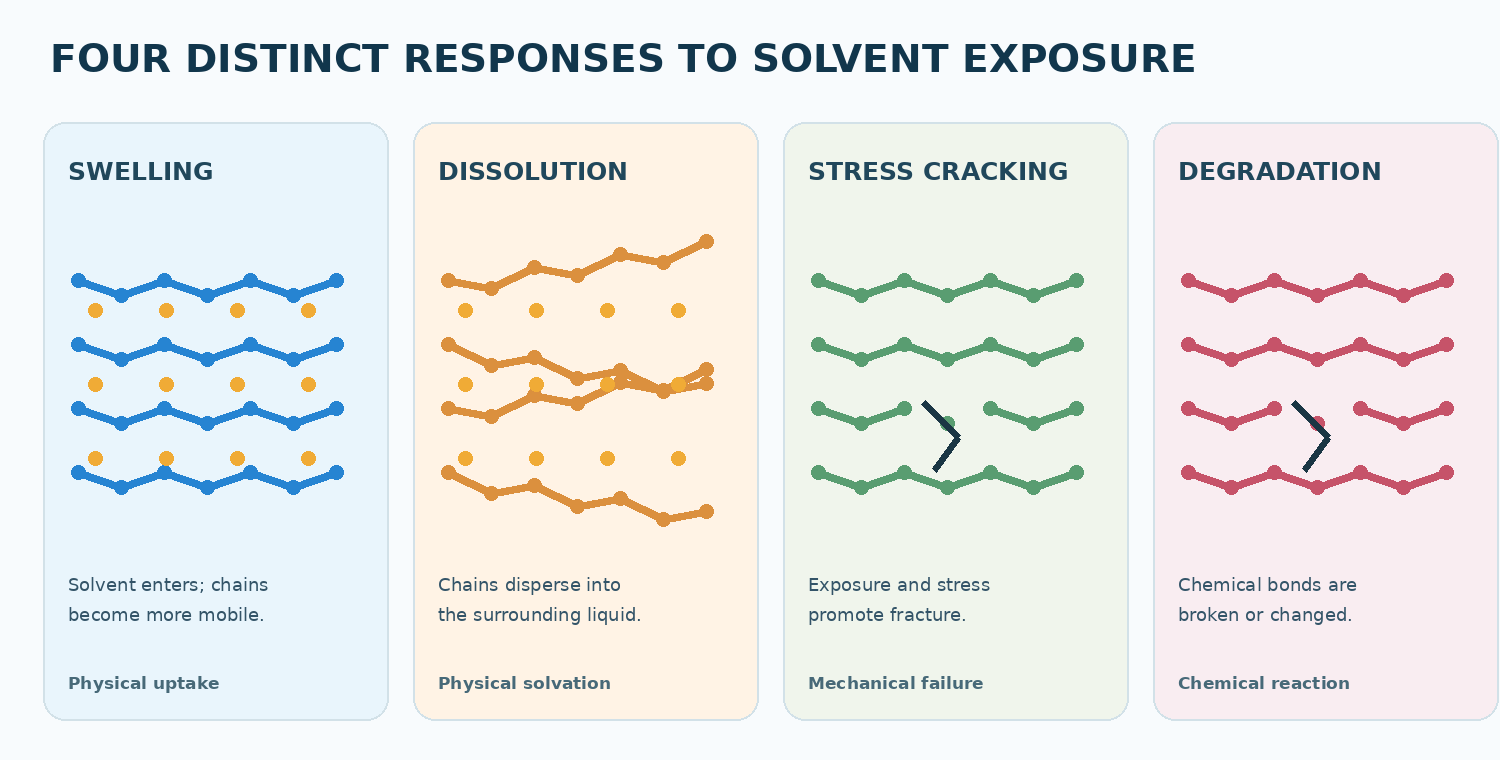
A. Swelling and plasticization
Small solvent molecules can enter a polymer, increase separation between some chains, and change their mobility. The object may become softer, heavier or larger. In some cases, the solvent later leaves; this does not prove that the original mechanical properties have returned.
B. Dissolution
If polymer chains become sufficiently solvated and can separate into the surrounding liquid, the material may dissolve. Dissolution is primarily a physical process: the polymer can lose its shape even without widespread cleavage of covalent backbone bonds.
C. Environmental stress cracking and delamination
Chemical exposure may interact with applied or residual mechanical stress to produce cracks. In layered prints, swelling can also weaken adhesion at interfaces and cause separation between printed roads or layers. A crack is evidence of failure, not by itself proof of a particular chemical reaction.
D. Chemical degradation
Actual chemical reactions can break chains or change functional groups. PLA contains hydrolysable ester bonds; water-mediated ester cleavage can shorten polymer chains, especially under conditions that accelerate hydrolysis. This is chemically different from simple solvent uptake [5].
| Process | Molecular change | Possible observation |
|---|---|---|
| Swelling | Solvent uptake and increased chain mobility | Mass or dimension increases; softening |
| Dissolution | Polymer chains disperse into liquid | Loss of shape or material |
| Stress cracking | Stress-assisted fracture in a chemical environment | Cracks, crazes, layer separation |
| Chemical degradation | Covalent bonds are chemically changed or broken | Changes in molar mass, properties or chemical spectra |
4. PLA versus PETG: Why their chemistry matters
Both are polyesters, but their monomer building blocks and processing behavior differ. PLA’s aliphatic polyester structure, material crystallinity and thermal history influence uptake and hydrolysis. PETG’s aromatic terephthalate-based copolyester chemistry and modified glycol composition give it a different set of properties. Neither has a universal ranking of “solvent-proof.”
What matters is the exact filament formulation, manufacturing process, liquid, concentration, temperature, contact duration and stress. Published tests provide useful starting evidence, but their results may not transfer exactly to an arbitrary brand or object.
5. Five common liquids and what they teach us
These examples are a conceptual guide—not permission to store reagents in 3D-printed containers.
| Liquid | Key chemistry | What to evaluate |
|---|---|---|
| Water | Highly polar and hydrogen-bonding; may be involved in slow ester hydrolysis. | Absorption, dimensional changes and longer-term hydrolysis under specified temperature/pH. |
| Ethanol | Polar protic solvent that can hydrogen bond. | Effects of concentration, time, plasticization and strength retention. |
| Ethyl acetate | Moderately polar ester solvent with affinity for some polymers. | Swelling, layer adhesion and potential dimensional changes. |
| Toluene | Aromatic solvent with important dispersion interactions. | Why water-solubility and a simple polar/nonpolar label are insufficient predictors. |
| Aqueous HCl | Acidic aqueous environment; concentration and temperature are crucial. | Acid-mediated effects, polymer hydrolysis susceptibility and property retention. |
In a 2019 study of additively manufactured thermoplastics, Erokhin and colleagues evaluated short-term solvent exposures, including ethanol, ethyl acetate and toluene. Their work identified important differences among printed polymers and showed that some printed PLA objects were incompatible with ethyl acetate and toluene under the studied test conditions [1]. These outcomes should not be converted into universal yes/no claims for every printed part.
A 2025 study of eight commercially available FDM materials exposed specimens to water, ethanol, isopropyl alcohol, aqueous hydrochloric acid, acetone and other agents for 1 hour, 24 hours and 7 days, then assessed retained tensile and impact properties. For one tested PETG material, after seven days in 99.5% ethanol, the authors reported approximately 94% retained tensile strength and roughly 90% retained impact resistance. After seven days in 37% hydrochloric acid, retention was approximately 80% and 72%, respectively [2].
Those concentrations are part of the result. A 37% HCl exposure is not equivalent to a 6 M HCl exposure, and a seven-day immersion is not equivalent to a brief splash.
6. Why 3D-printed plastics can be especially vulnerable
Fused-deposition modeling (FDM/FFF) constructs parts layer by layer. Internal voids, imperfect bonding between adjacent roads, gaps between layers and residual stresses can give liquids additional access and contribute to failure. Surface area, wall thickness, infill and print orientation also matter.
Erokhin and colleagues compared a conventionally extruded PLA specimen with a printed specimen made of the same material, geometry and mass. Under dichloromethane exposure, the printed specimen lost its shape faster—demonstrating that the processing method, not only the resin identity, affected performance [1]. That comparison involved dichloromethane; it does not automatically predict the same relative rates in ethanol or water.
7. How scientists measure chemical damage
Appearance alone is not enough. A material can look intact while becoming weaker. ASTM D543-21 describes practices for evaluating plastic resistance to chemical reagents and emphasizes matching the reagent, concentration, temperature, time and stress to the intended use [3].
- Mass and dimensions: Measure solvent uptake, swelling or loss of material, with clearly defined drying and weighing procedures.
- Tensile and impact properties: Compare exposed specimens with unexposed controls; report replicates and variability.
- Microscopy: Inspect cracks, voids, interfaces and fractured surfaces.
- ATR-IR: Look for supported evidence of changes in functional groups; an unchanged spectrum does not rule out all physical damage.
- Thermal analysis: DSC can help characterize glass transitions and other thermal properties where the method applies.
A simple percentage mass change is 100 × (mafter − mbefore)/mbefore. A positive result could reflect solvent uptake, but without additional evidence it does not establish a particular mechanism. Distinguish wet mass immediately after exposure from mass after a validated drying procedure.
8. What published studies really show
The 2019 Scientific Reports study was primarily concerned with interactions at solid–liquid interfaces, observable failure modes and comparisons across printed materials. Its rapid tests included a defined specimen geometry, exposure conditions and a small external load [1].
The 2025 Polymers study asked a different question: how much mechanical performance specimens retained following immersion and subsequent tests. Under its conditions, PETG retained relatively high strength in several milder environments but deteriorated substantially in acetone. The reported PETG tensile-strength retention after seven days in acetone was approximately 30% of its unexposed value. PLA was also highly affected by acetone in the study [2].
These studies are best read together, not treated as competing universal compatibility charts. Differences in filament grade, test geometry, immersion time, mechanical loading, measurement endpoint and drying conditions can explain why results vary. A sample with no visible distortion during a brief test could still lose substantial strength after prolonged exposure.
9. Can you use 3D prints in the chemistry laboratory?
Printed parts can be useful for supports, fixtures, instrument guides and holders that are not intended to contain chemicals. For direct chemical contact—particularly with volatile solvents, corrosive acids, pressure or heating—use approved labware and the manufacturer’s verified compatibility information. A coating, sealant or high infill percentage does not automatically make a printed container leak-tight or chemically safe.
ASTM D543 stresses that short-term compatibility results cannot be assumed to predict service life under continuous immersion, and that conditions should match the real application [3]. Never use a student-made solvent exposure experiment as a substitute for approved chemical storage requirements.
For more chemistry of materials, read Smart Polymers Explained. To connect material analysis to spectroscopy, see How to Read an IR Spectrum and our TLC Troubleshooting Guide.
10. Questions students often ask
Is PETG always more resistant to solvents than PLA?
No. Some PETG formulations perform well in particular environments, but chemical resistance is solvent- and condition-dependent. The 2025 study recorded considerable PETG strength loss in acetone [2].
If a printed part does not swell, is it safe?
Not necessarily. It may be losing strength or accumulating damage not visible during a brief inspection. Assessment must match the intended application.
Does a printed plastic dissolve because covalent bonds break?
Not usually as part of ordinary physical dissolution. Dissolution disperses polymer chains into a liquid. Chemical degradation, such as ester hydrolysis, involves chemical bond cleavage.
Can I make an FDM printed part solvent-proof by using 100% infill?
No. Infill does not eliminate all defects, residual stress or intrinsic solvent–polymer interactions. Manufacturer and application-specific verification remain necessary.
References and further reading
- Erokhin, K. S., Gordeev, E. G., & Ananikov, V. P. (2019). Revealing interactions of layered polymeric materials at solid-liquid interface for building solvent compatibility charts for 3D printing applications. Scientific Reports, 9, 20177. DOI:10.1038/s41598-019-56350-w.
- Kaptan, A. (2025). Investigation of the effect of exposure to liquid chemicals on the strength performance of 3D-printed parts from different filament types. Polymers, 17(12), 1637. DOI:10.3390/polym17121637.
- ASTM International. (2021). ASTM D543-21: Standard Practices for Evaluating the Resistance of Plastics to Chemical Reagents. DOI:10.1520/D0543-21.
- Hansen, C. M. (2007). Hansen Solubility Parameters: A User’s Handbook (2nd ed.). CRC Press. Publisher and handbook information.
- Review: Accelerating the Biodegradation of Poly(lactic acid) through the Inclusion of Plant Fibers: A Review of Recent Advances. (2023). Open-access review of PLA hydrolysis.
© 2026 IntoChemistry. Original educational content; scientific claims are limited to the cited conditions. Not chemical-handling or storage approval. Last reviewed November 2026.