
Organic Acid–Base Reactions: pKa & Equilibrium
Use conjugate acid strength and approximate pKa values to predict acid–base reaction direction.
Understand the concept
Brønsted–Lowry acids donate H⁺ and bases accept H⁺. The conjugate base forms when an acid loses a proton; the conjugate acid forms when a base gains one.
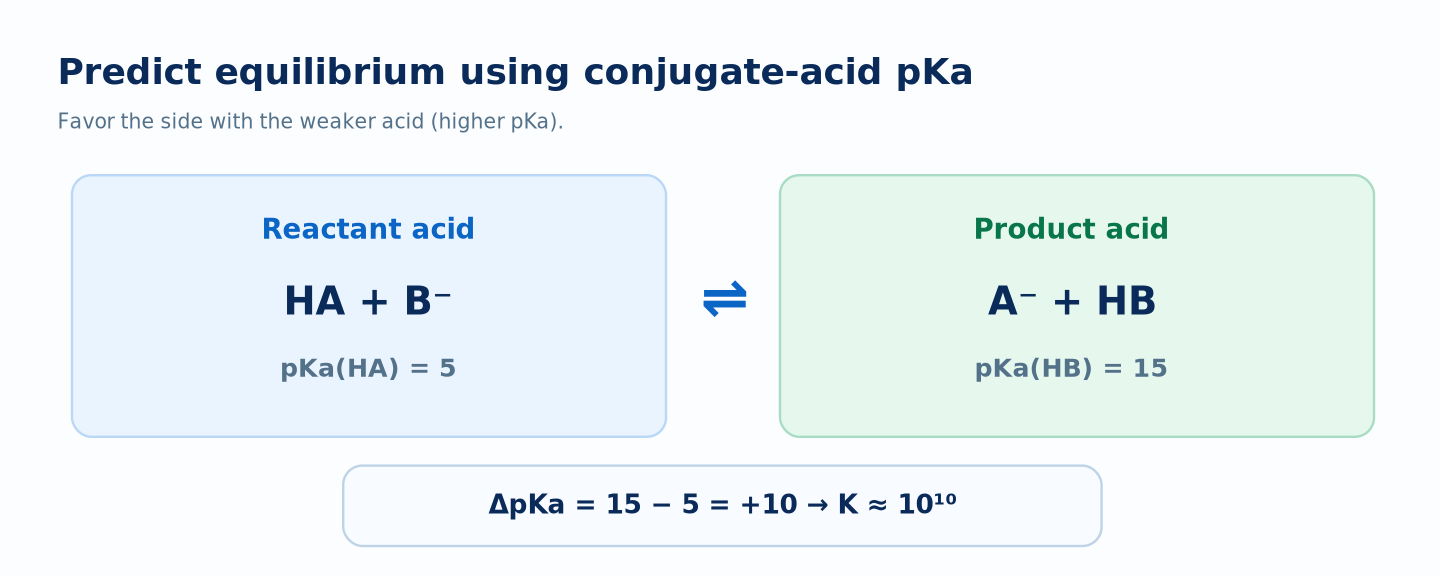
For HA + B⁻ ⇌ A⁻ + HB, an approximate equilibrium constant is K ≈ 10pKa(HB) − pKa(HA) using comparable solvent conditions. Equilibrium tends toward the weaker acid and weaker base.
A reliable four-step approach
- Label the acid and base on each side of the reaction.
- Find the pKa of the reactant acid and product conjugate acid.
- Compare the two pKa values: larger pKa means weaker acid.
- Estimate K ≈ 10^(pKa product acid − pKa reactant acid), when appropriate.
Visual explanation
Work through the examples
Can hydroxide largely deprotonate acetic acid? pKa acetic acid ≈ 4.8; pKa water ≈ 15.7.
OH⁻ removes H⁺ from CH₃COOH to form CH₃COO⁻ and H₂O. The product acid (H₂O) has much larger pKa. ΔpKa ≈ 15.7 − 4.8 = 10.9.
Result: Strongly product-favored; K approximately 10^10.9 under comparable conditions.
Is NH₂⁻ sufficiently basic to deprotonate a terminal alkyne? pKa ≈ 25; pKa NH₃ ≈ 38.
The acid on the product side is ammonia, which has a higher pKa than the terminal alkyne. ΔpKa ≈ 38 − 25 = 13.
Result: Strongly product-favored; an acetylide anion can form.
Common mistakes
- Confusing the stronger acid with the higher-pKa acid.
- Comparing pKa values for different solvents without caveats.
- Neglecting conjugate acid formation after proton transfer.
Check your understanding
Which acid is weaker: pKa 5 or pKa 16?
Higher pKa corresponds to a weaker acid under comparable conditions.
Complete the interactive practice below to check more questions and review explanations.
Interactive Practice
Answer curated questions, then review the scientific explanation.
Loading practice questions…