

Atomic Structure, Isotopes & Atomic Mass
Connect protons, neutrons, electrons, isotopes and weighted-average atomic mass.
Learn the concept, then practice it
Connect protons, neutrons, electrons, isotopes and weighted-average atomic mass. Start with the illustrated overview, follow the calculation, and try the questions.
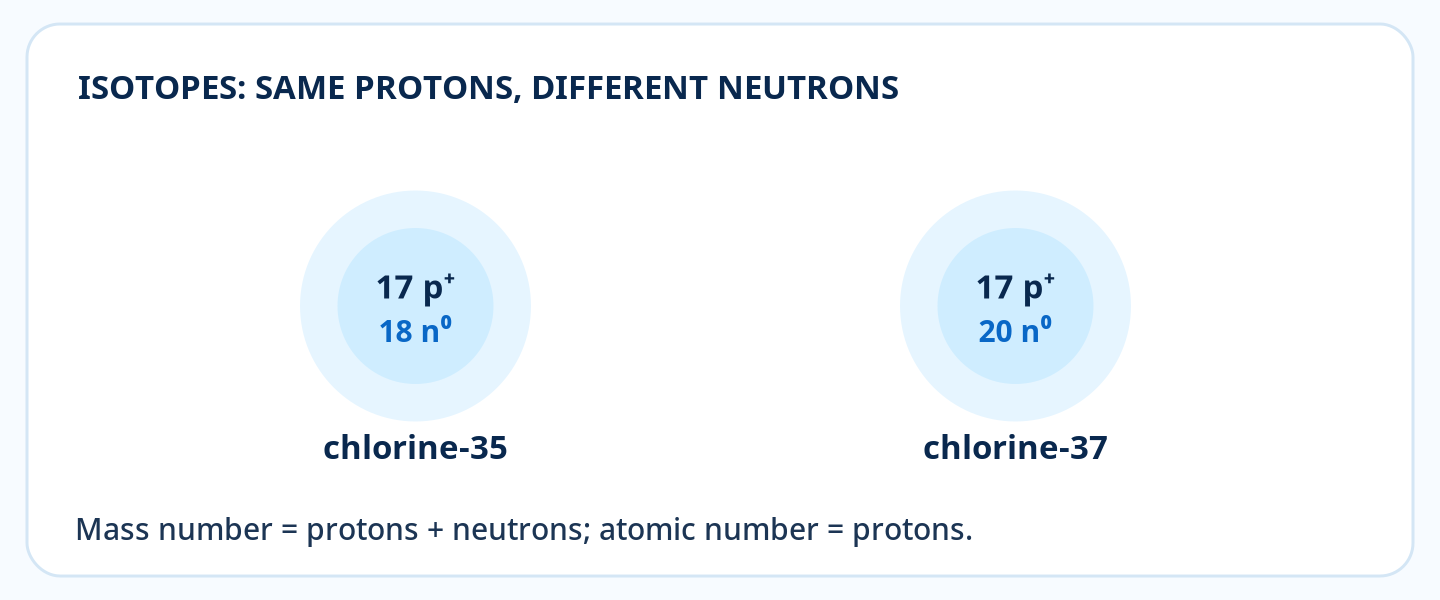
mass number A = protons + neutrons; average atomic mass = Σ(fraction × isotope mass)
Identify the particles
The atomic number Z equals the number of protons. A neutral atom has the same number of electrons; ions differ in electron count.
Read isotope notation
The mass number A counts protons plus neutrons. Isotopes of one element have the same proton number and different neutron numbers.
Compute an average
Periodic-table masses are weighted averages of naturally occurring isotopes, not the mass number of a single atom.
How many neutrons are in chlorine-37?
Chlorine has atomic number 17, so neutrons = 37 − 17 = 20. A neutral chlorine-37 atom also has 17 electrons.
Common mistake
Do not subtract electrons to calculate neutron count; use mass number minus proton number.
Practice with feedback
Select an answer to see a specific explanation. For more questions, open the General Chemistry Exam Center.
Loading local practice questions…
Keep learning
Try the full General Chemistry Exam Center for a mixed review, or select another topic in the Learning Center.
Open General Chemistry Exam Center →