
How to Balance Chemical Equations
Learn a repeatable method for balancing reactions without changing the chemical substances.
Why equations must be balanced
A chemical equation records the identities and relative amounts of substances in a reaction. In an ordinary chemical reaction, atoms are rearranged rather than created or destroyed, so the number of each element’s atoms must match on both sides.
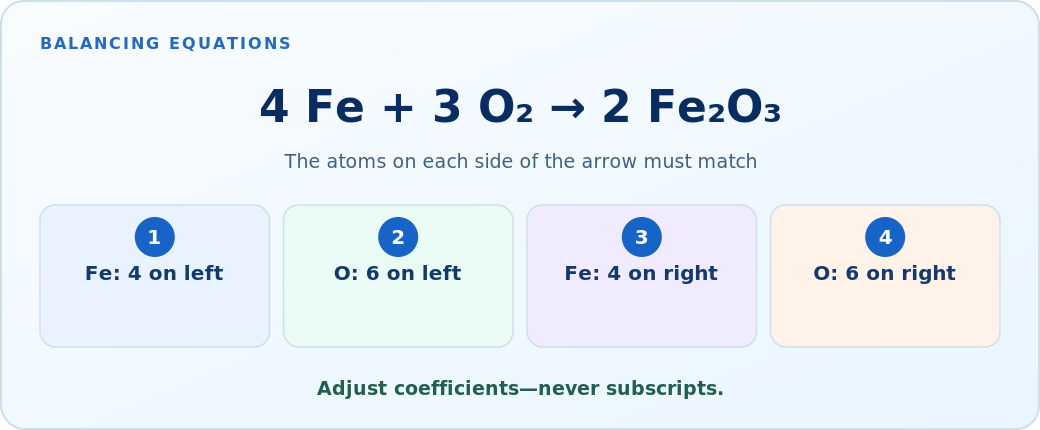
Five steps for balancing equations
- Write the correct formulas for every reactant and product.
- Count the atoms of each element on both sides.
- Adjust coefficients only, beginning with an element that appears in relatively few substances.
- Recount every element after each adjustment. If an unchanged polyatomic ion appears on both sides, you can sometimes treat it as a unit.
- Reduce to the smallest whole-number coefficients and verify all atom counts.
See conservation of atoms
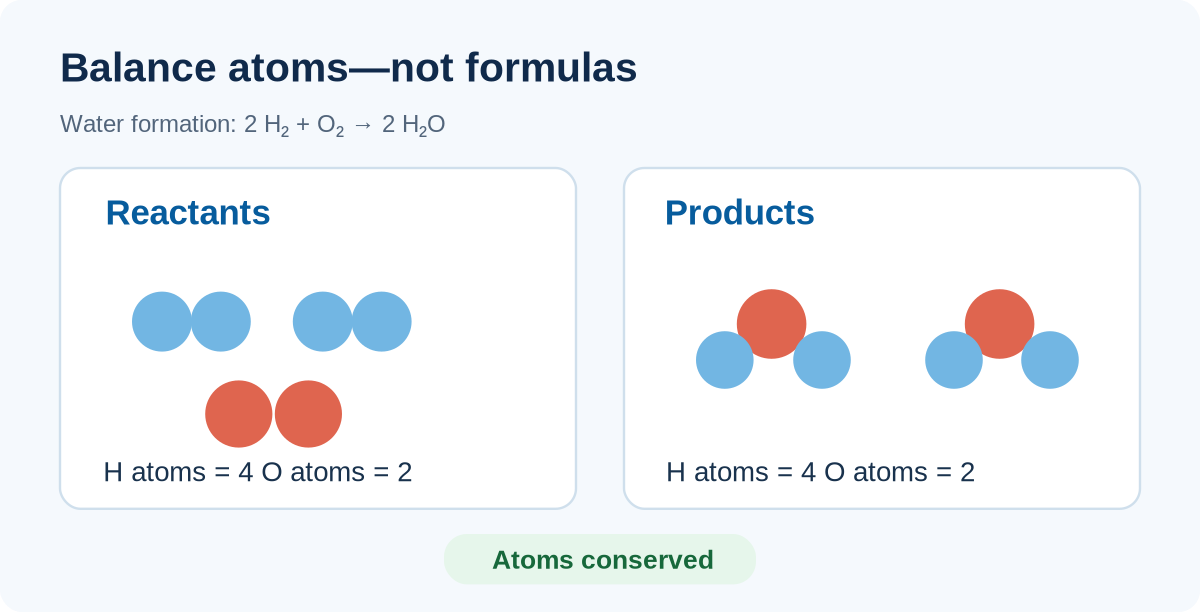
Three worked examples
Hydrogen and oxygen form water
- Start: H₂ + O₂ → H₂O. Left O = 2; right O = 1.
- Put 2 before H₂O: H₂ + O₂ → 2 H₂O. Now right H = 4.
- Put 2 before H₂: 2 H₂ + O₂ → 2 H₂O.
- Check: both sides contain 4 H and 2 O atoms.
Balanced: 2 H₂ + O₂ → 2 H₂O.
Iron reacts with oxygen
- Start: Fe + O₂ → Fe₂O₃.
- Balance oxygen using a multiple of 6: Fe + 3 O₂ → 2 Fe₂O₃.
- Now the product has 4 Fe atoms; put 4 before Fe.
Balanced: 4 Fe + 3 O₂ → 2 Fe₂O₃.
Propane combustion
- Start: C₃H₈ + O₂ → CO₂ + H₂O.
- Balance carbon: 3 CO₂. Balance hydrogen: 4 H₂O.
- Right side now contains 10 oxygen atoms, requiring 5 O₂.
Balanced: C₃H₈ + 5 O₂ → 3 CO₂ + 4 H₂O.
Mistakes to avoid
- Changing subscripts: Turning H₂O into H₂O₂ changes water into another chemical substance.
- Forgetting diatomic elements: Elemental H₂, N₂, O₂, F₂, Cl₂, Br₂ and I₂ are often written as pairs under standard conditions.
- Stopping at a multiple: 4 H₂ + 2 O₂ → 4 H₂O balances, but reduce the coefficients to 2:1:2.
- Ignoring parentheses: Ca(OH)₂ contains 2 oxygen and 2 hydrogen atoms from hydroxide.
Check your understanding
Why can’t you change O₂ to O₃ to balance a reaction?
Because the subscript identifies the chemical species. O₂ and O₃ are different substances; changing a formula changes the reaction.
Does the equation need equal numbers of molecules on each side?
No. It must conserve the number of atoms of every element, not the total number of molecules.
Interactive How to Balance Chemical Equations Practice
Apply what you have learned using immediate feedback.
Balance the equation
Type the smallest positive whole-number coefficients. Do not change chemical formulas.