

Acid–Base Titrations & Equivalence
Calculate equivalence volumes and explain indicator and titration curves.
Learn the concept, then practice it
Calculate equivalence volumes and explain indicator and titration curves. Start with the illustrated overview, follow the calculation, and try the questions.
at strong monoprotic acid–base equivalence: Macid Vacid = Mbase Vbase
Write the reaction
Start with balanced mole ratios. For HCl + NaOH, one mole of acid reacts with one mole of base.
Find the equivalence point
At equivalence, acid and base have reacted in stoichiometric amounts. An indicator endpoint is an observed signal and may not coincide perfectly.
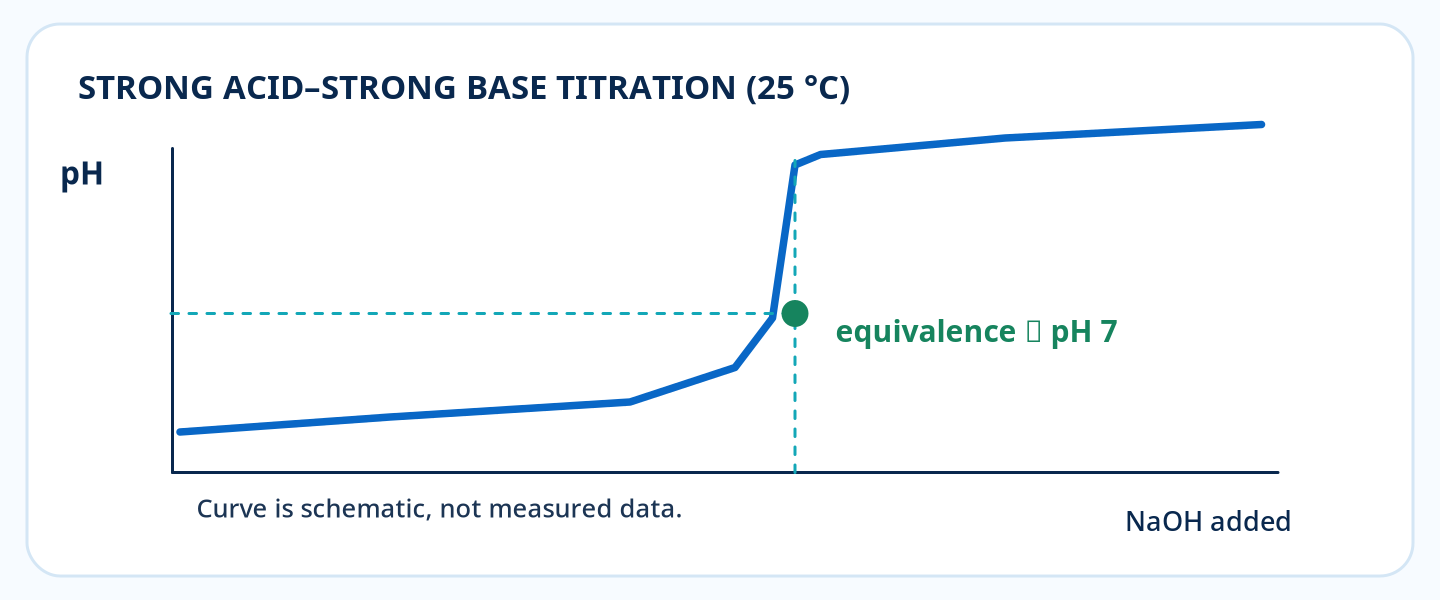
Read the titration curve
For strong acid–strong base titration at 25 °C, the ideal equivalence-point pH is approximately 7. Other acid–base combinations can differ.
What volume of 0.100 M NaOH neutralizes 25.00 mL of 0.100 M HCl?
n(HCl) = 0.100 × 0.02500 = 0.00250 mol. At 1:1 stoichiometry VNaOH = 0.00250 / 0.100 = 0.0250 L.
Common mistake
The indicator endpoint is an experimental observation; equivalence is a stoichiometric condition. Their difference contributes to titration error.
Practice with feedback
Select an answer to see a specific explanation. For more questions, open the General Chemistry Exam Center.
Loading local practice questions…
Loading educational calculator…
Keep learning
Try the full General Chemistry Exam Center for a mixed review, or select another topic in the Learning Center.
Open General Chemistry Exam Center →