
INTOCHEMISTRY / CHROMATOGRAPHY
Thin-Layer Chromatography: Rf
Measure the traveled distances correctly and interpret TLC migration with appropriate caution.
Determine Rf from distances referenced to the baseline and explain how plate and solvent conditions affect migration.
1. What moves on a TLC plate?
A sample spot moves along a stationary phase as the mobile-phase solvent rises. The Rf value describes spot migration relative to the mobile phase under the conditions of that run.
2. Measure from the baseline
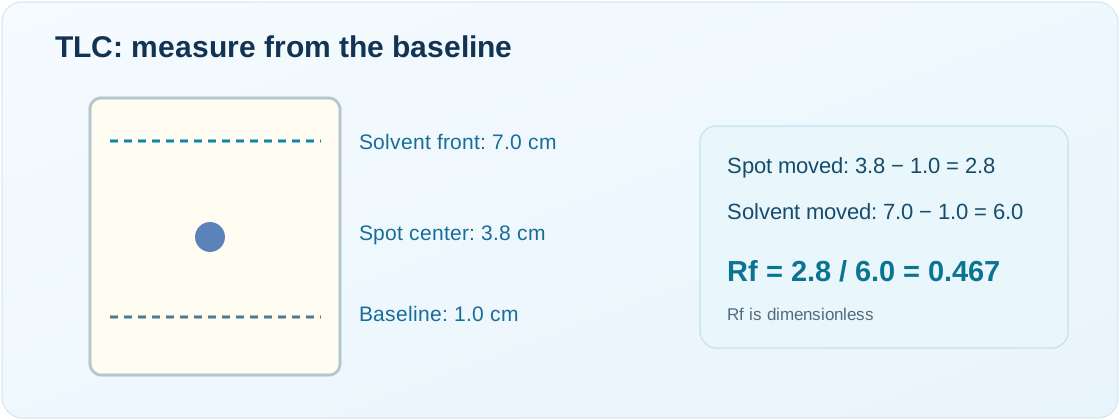
Mark the original spotting baseline and the solvent front before the plate dries. Measure from the baseline to the center of the spot and from the same baseline to the solvent front. Rf = spot travel distance ÷ solvent travel distance. Rf has no units.
3. Worked example
If the baseline is at 1.0 cm, the center of a spot at 3.8 cm, and the solvent front at 7.0 cm, spot travel is 2.8 cm and solvent travel is 6.0 cm. Rf = 2.8 ÷ 6.0 = 0.467.
4. Interpret, do not overclaim
On ordinary polar silica with the same developing solvent, a more strongly adsorbed compound tends to travel less. But Rf depends on plate chemistry, solvent, loading and temperature; a single matching Rf is not proof of chemical identity. Compare matched standards and complementary evidence.
Quick concept check
A spot moves 2.4 cm while the solvent front moves 6.0 cm from the same baseline. Calculate Rf.
Show worked answer
Rf = 2.4 ÷ 6.0 = 0.400 (dimensionless).