

Chemical Equilibrium, Q & K
Write equilibrium expressions and compare reaction quotient Q with K.
Learn the concept, then practice it
Write equilibrium expressions and compare reaction quotient Q with K. Start with the illustrated overview, follow the calculation, and try the questions.
for aA + bB ⇌ cC + dD, Kc = [C]^c[D]^d / ([A]^a[B]^b)
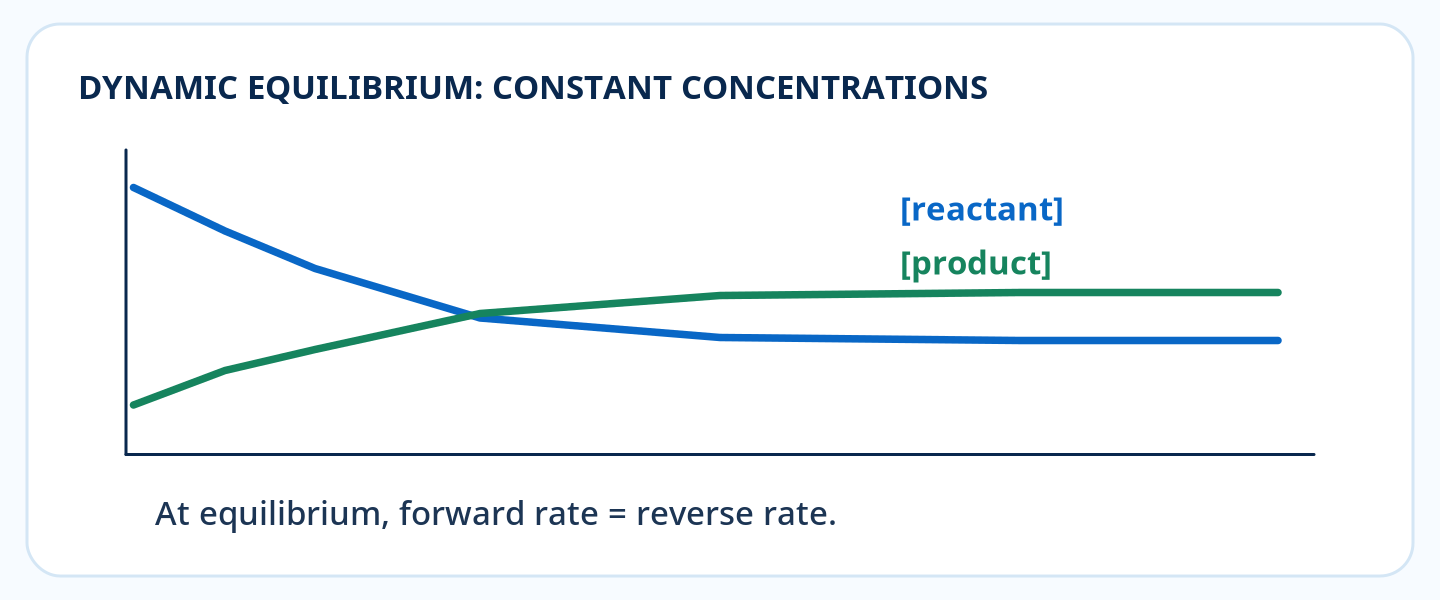
Equilibrium is dynamic
Forward and reverse reactions continue at equal rates at equilibrium; concentrations are constant, not necessarily equal.
Write K correctly
Use stoichiometric coefficients as exponents. Omit pure solids and liquids from introductory equilibrium expressions.
Compare Q and K
Q < K favors a net forward shift; Q > K favors a net reverse shift; Q = K means the composition is at equilibrium.
For 2 NO₂(g) ⇌ N₂O₄(g), [N₂O₄] = 0.040 M and [NO₂] = 0.020 M at equilibrium. Find Kc.
Kc = [N₂O₄]/[NO₂]² = 0.040/(0.020)² = 100 (using the introductory concentration convention).
Common mistake
A catalyst helps equilibrium be reached more quickly but does not change K or the final equilibrium composition at fixed temperature.
Practice with feedback
Select an answer to see a specific explanation. For more questions, open the General Chemistry Exam Center.
Loading local practice questions…
Keep learning
Try the full General Chemistry Exam Center for a mixed review, or select another topic in the Learning Center.
Open General Chemistry Exam Center →