

Electron Configurations & Orbital Diagrams
Fill orbitals correctly and relate electron arrangement to the periodic table.
Learn the concept, then practice it
Fill orbitals correctly and relate electron arrangement to the periodic table. Start with the illustrated overview, follow the calculation, and try the questions.
s holds 2, p holds 6, d holds 10, f holds 14 electrons
Follow orbital filling
Use the lowest-available-energy orbitals while respecting electron capacities. A common introductory order begins 1s, 2s, 2p, 3s, 3p, 4s, 3d.
Apply Pauli and Hund
An orbital can hold at most two electrons with opposite spins; in degenerate orbitals, place electrons singly with parallel spins before pairing.
Handle transition-metal ions
When removing electrons from a transition-metal atom, remove electrons from the highest principal quantum number first—typically 4s before 3d for first-row transition metals.
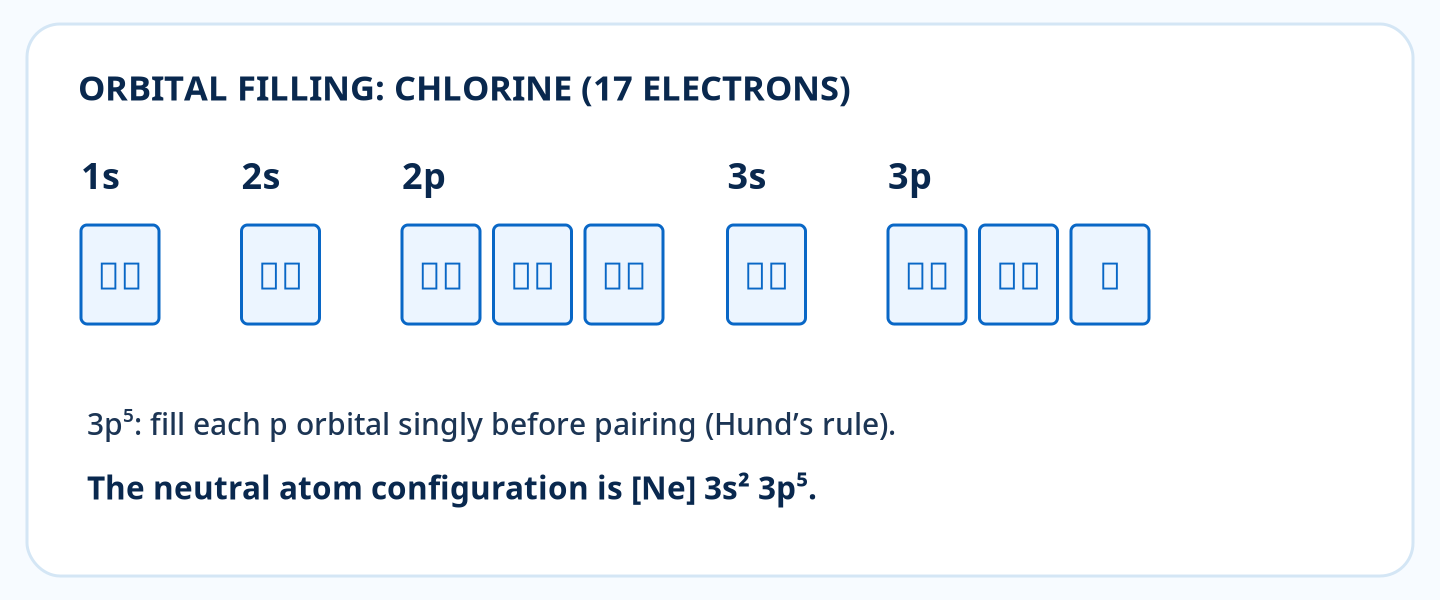
Write the electron configuration of chlorine (Z = 17).
Fill 17 electrons: 1s² 2s² 2p⁶ 3s² 3p⁵. Shorthand: [Ne] 3s² 3p⁵.
Common mistake
Do not apply Aufbau as an exception-free law: some atoms such as Cr and Cu have configurations beyond the simplest filling prediction.
Practice with feedback
Select an answer to see a specific explanation. For more questions, open the General Chemistry Exam Center.
Loading local practice questions…
Keep learning
Try the full General Chemistry Exam Center for a mixed review, or select another topic in the Learning Center.
Open General Chemistry Exam Center →