

Naming Molecular Compounds
Learn Greek prefixes, formula writing and clear distinctions from ionic naming.
Learn the concept, then practice it
Learn Greek prefixes, formula writing and clear distinctions from ionic naming. Start with the illustrated overview, follow the calculation, and try the questions.
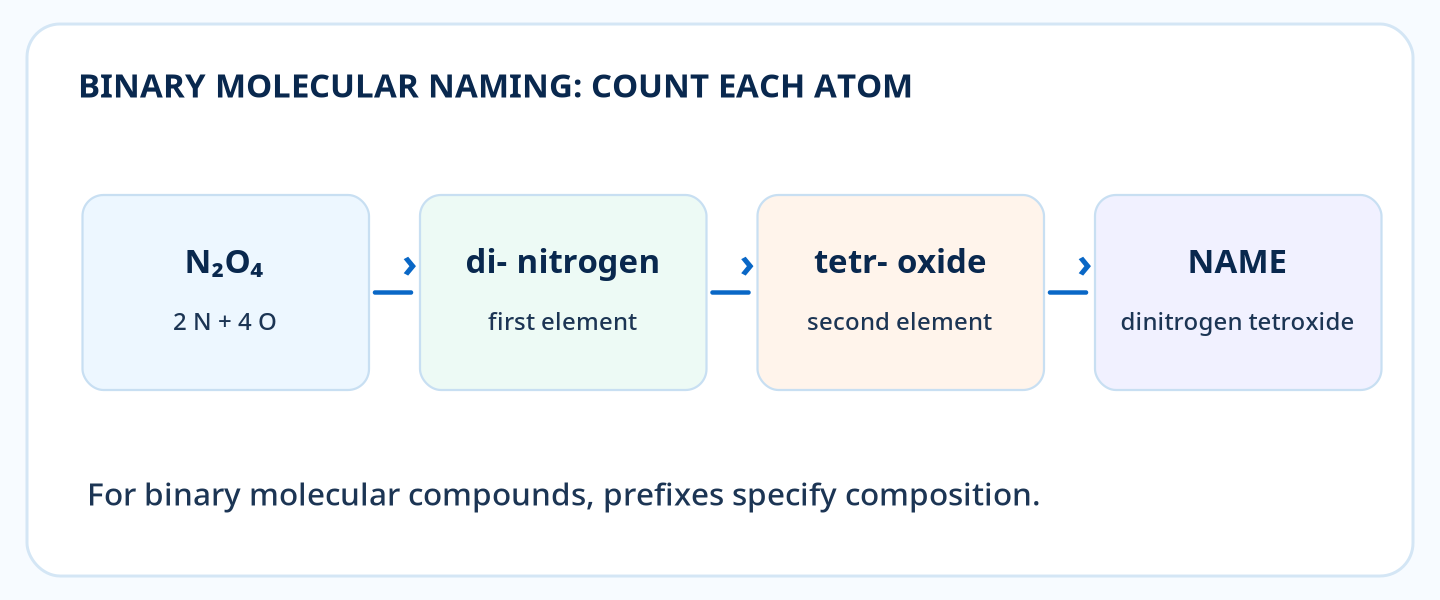
binary covalent name = prefix + first element + prefix + second-element -ide
Classify first
Two nonmetals often form a binary molecular compound. Unlike simple ionic naming, the compound name usually uses prefixes to show the atom counts.
Use prefixes consistently
Mono-, di-, tri-, tetra-, penta-, and hexa- mean 1–6. The first element usually omits mono-; the second element receives an -ide ending.
Read the formula
Read element symbols in order, then translate each subscript. Learn common vowel elisions such as monoxide and tetroxide.
Name N₂O₄.
There are two nitrogen atoms (di-) and four oxygen atoms (tetra-); the conventional spelling shortens tetraoxide to tetroxide.
Common mistake
Do not use Greek prefixes for a simple ionic formula such as CaCl₂, which is calcium chloride.
Practice with feedback
Select an answer to see a specific explanation. For more questions, open the General Chemistry Exam Center.
Loading local practice questions…
Keep learning
Try the full General Chemistry Exam Center for a mixed review, or select another topic in the Learning Center.
Open General Chemistry Exam Center →