

Reaction Kinetics & Rate Laws
Analyze reaction-rate data, activation energy and the effect of catalysts.
Learn the concept, then practice it
Analyze reaction-rate data, activation energy and the effect of catalysts. Start with the illustrated overview, follow the calculation, and try the questions.
rate = k[A]^m[B]^n (orders determined experimentally)
Rate describes change
Reaction rate is the change of a concentration per unit time. Stoichiometric factors must be considered when comparing rates for different reactants/products.
Infer orders from data
Experimental measurements reveal reaction order. Coefficients in a balanced equation do not generally equal rate-law exponents for an overall reaction.
Use activation energy
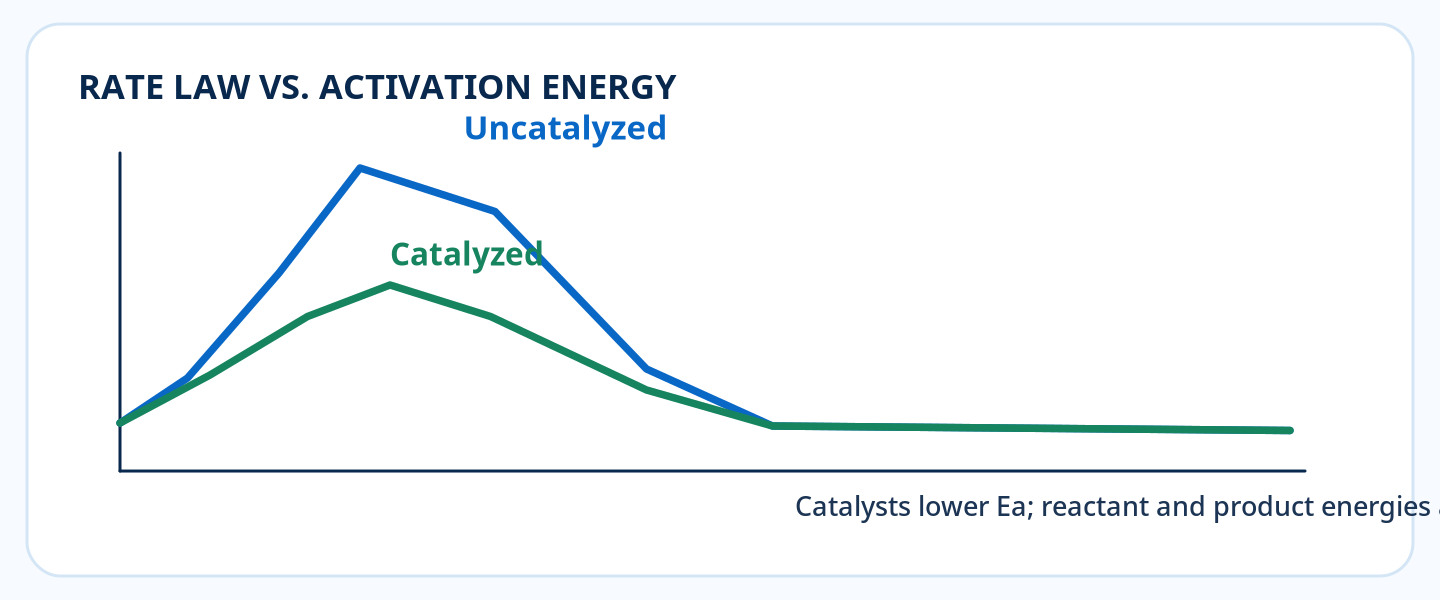
A catalyst provides an alternative pathway with a lower effective activation-energy barrier without changing reaction ΔH or K.
If a reaction is first order in A, what happens to the rate when [A] doubles?
rate = k[A]. Doubling [A] gives rate′ = k(2[A]) = 2 × original rate.
Common mistake
Never assign overall reaction orders from the balanced chemical equation unless a valid elementary-step mechanism justifies it.
Practice with feedback
Select an answer to see a specific explanation. For more questions, open the General Chemistry Exam Center.
Loading local practice questions…
Keep learning
Try the full General Chemistry Exam Center for a mixed review, or select another topic in the Learning Center.
Open General Chemistry Exam Center →