

Intermolecular Forces & Properties
Distinguish dispersion, dipole–dipole and hydrogen bonding and predict trends.
Learn the concept, then practice it
Distinguish dispersion, dipole–dipole and hydrogen bonding and predict trends. Start with the illustrated overview, follow the calculation, and try the questions.
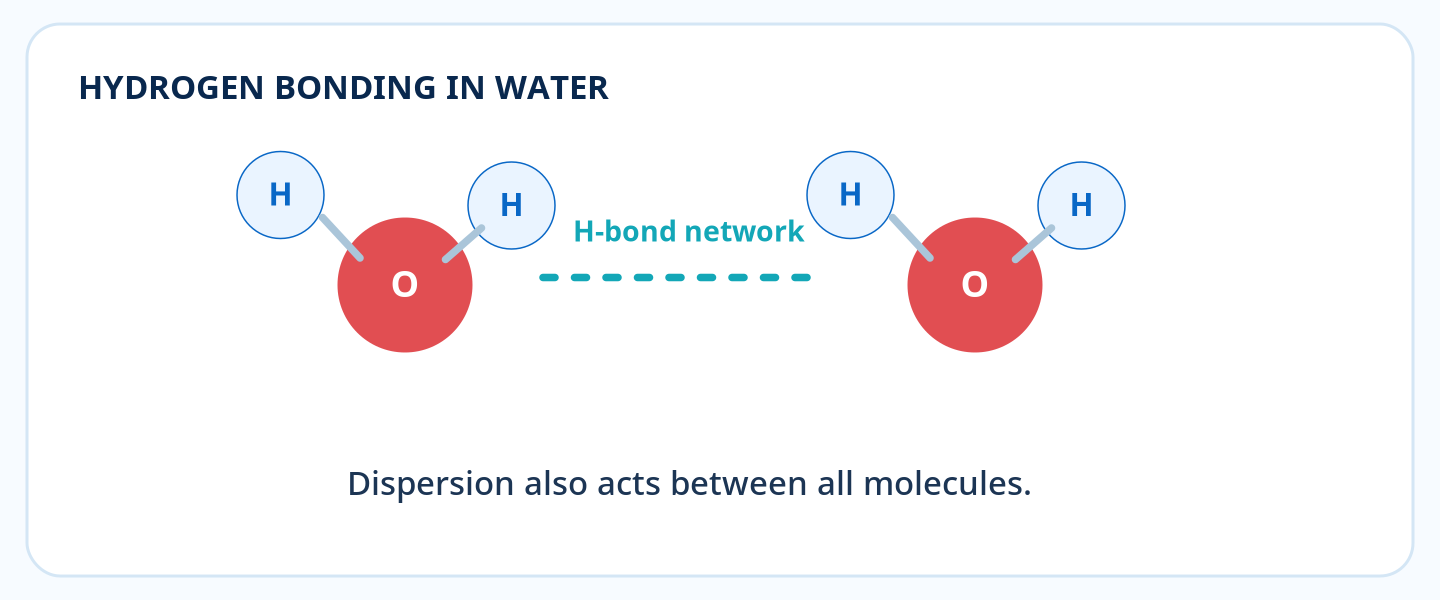
all particles have dispersion forces; H bonding requires H bonded to N, O or F
Start with dispersion
London dispersion forces exist in all atoms and molecules and tend to strengthen as electron clouds become larger and more polarizable.
Check permanent polarity
Polar molecules also exhibit dipole–dipole interactions. Molecular geometry determines whether bond dipoles cancel.
Recognize hydrogen bonding
N–H, O–H, and F–H groups can participate in especially strong dipole-based attractions involving suitable lone pairs.
Why is the boiling point of water much higher than that of H₂S?
H₂O forms an extensive hydrogen-bond network, while H₂S cannot form comparable conventional hydrogen bonding; intermolecular attractions differ substantially.
Common mistake
Do not confuse intermolecular forces with covalent bonds within a molecule. Boiling generally separates molecules, not atoms within molecules.
Practice with feedback
Select an answer to see a specific explanation. For more questions, open the General Chemistry Exam Center.
Loading local practice questions…
Keep learning
Try the full General Chemistry Exam Center for a mixed review, or select another topic in the Learning Center.
Open General Chemistry Exam Center →