

Net Ionic Equations & Precipitation
Identify dissolved spectators and write correctly balanced net ionic equations.
Learn the concept, then practice it
Identify dissolved spectators and write correctly balanced net ionic equations. Start with the illustrated overview, follow the calculation, and try the questions.
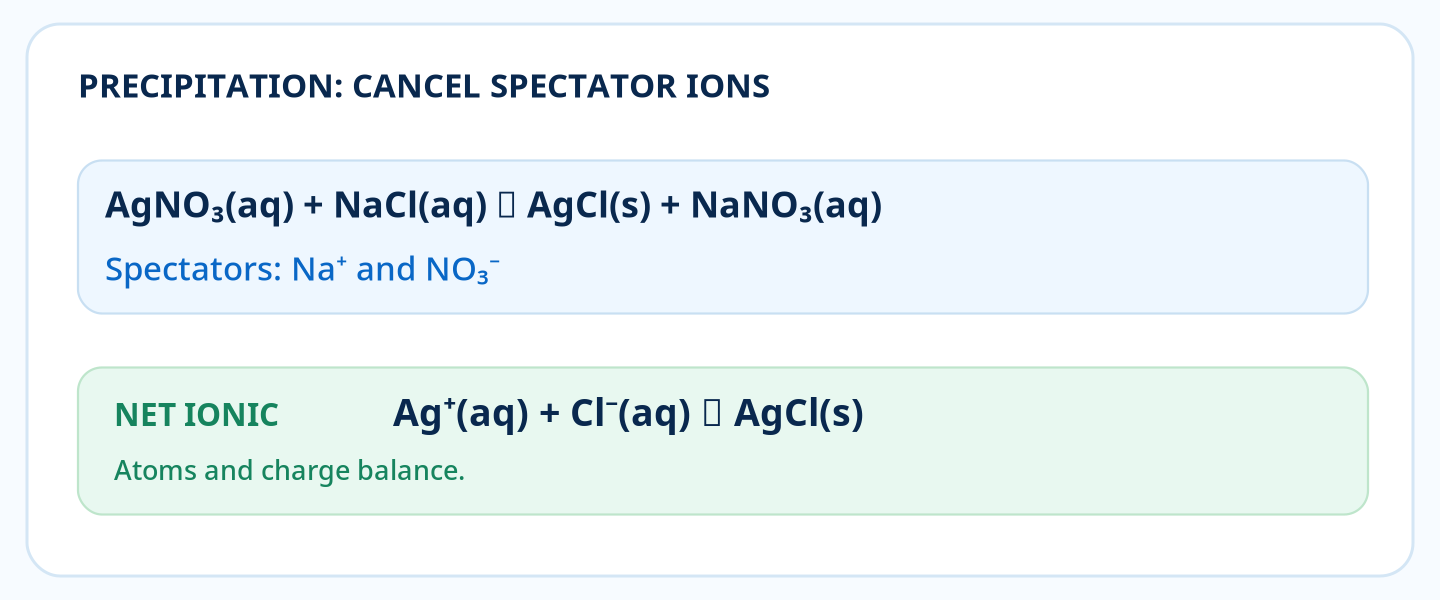
molecular → complete ionic → cancel spectators → net ionic
Decide what dissolves
Use solubility guidelines to determine which products remain aqueous and which form a precipitate; nitrates and alkali-metal salts are generally soluble.
Separate only strong electrolytes
In complete ionic equations, split soluble ionic compounds into ions. Do not split solids, liquids, gases, or weak electrolytes.
Check atoms and charge
Cancel spectator ions and verify that both atoms and overall electric charge balance.
Mix aqueous AgNO₃ and NaCl. Write the net ionic equation.
AgNO₃(aq) + NaCl(aq) → AgCl(s) + NaNO₃(aq). Dissociate the soluble salts and cancel Na⁺ and NO₃⁻.
Common mistake
A solid precipitate stays intact in an ionic equation. Cancelling a reacting ion is not allowed.
Practice with feedback
Select an answer to see a specific explanation. For more questions, open the General Chemistry Exam Center.
Loading local practice questions…
Keep learning
Try the full General Chemistry Exam Center for a mixed review, or select another topic in the Learning Center.
Open General Chemistry Exam Center →