

Thermochemistry & Calorimetry
Calculate heat transfer, interpret energy signs and solve calorimetry problems.
Learn the concept, then practice it
Calculate heat transfer, interpret energy signs and solve calorimetry problems. Start with the illustrated overview, follow the calculation, and try the questions.
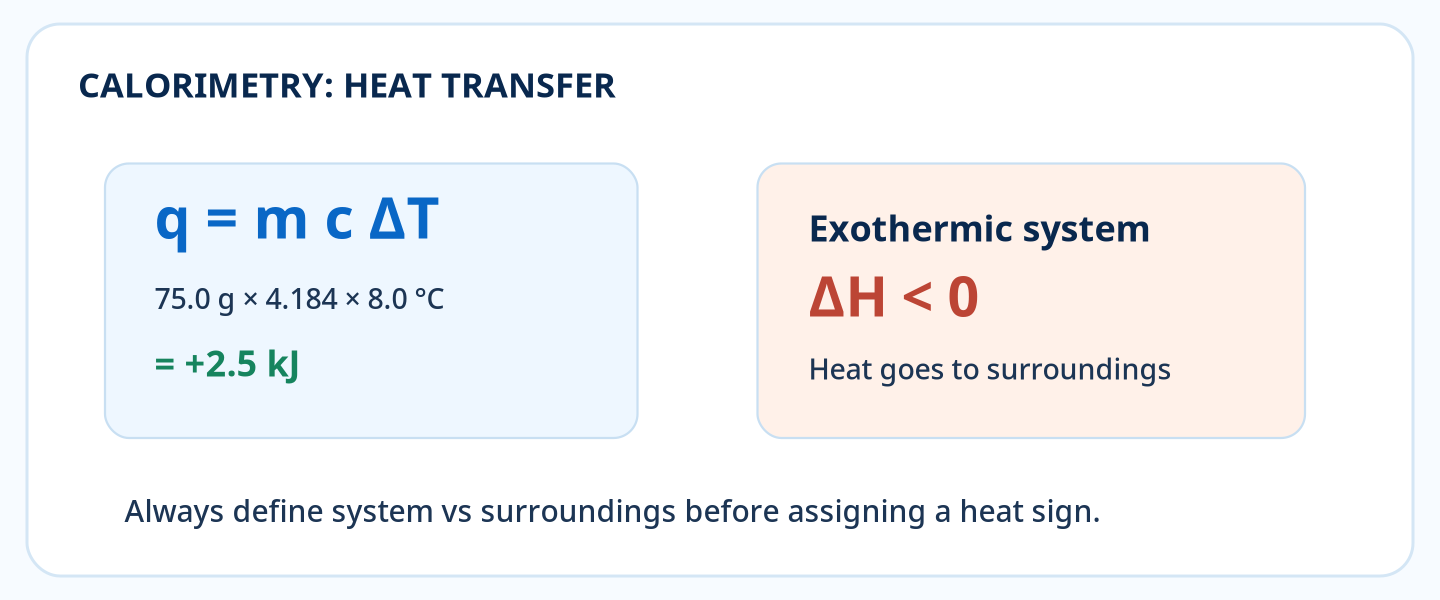
q = mcΔT; at constant pressure with only PV work, ΔH = qₚ
Define the system
Specify what is reacting and what counts as surroundings. Heat absorbed by one part is released by another in an insulated model.
Calculate measured heat
For a substance with known specific heat capacity, use q = mc(Tfinal − Tinitial). Include grams, J/(g °C), and °C.
Interpret the sign
Exothermic reactions have negative ΔH when heat flows from system to surroundings; endothermic reactions have positive ΔH.
How much heat warms 75.0 g of water from 20.0 °C to 28.0 °C?
q = (75.0 g)(4.184 J g⁻¹ °C⁻¹)(8.0 °C) = 2.5104 × 10³ J, reported as 2.5 × 10³ J given ΔT = 8.0 °C. Sign is positive for the warming water.
Common mistake
The heat gained by water is not automatically the reaction enthalpy. In an insulated calorimeter, qreaction ≈ −qsurroundings after considering all relevant heat capacities.
Practice with feedback
Select an answer to see a specific explanation. For more questions, open the General Chemistry Exam Center.
Loading local practice questions…
Loading educational calculator…
Keep learning
Try the full General Chemistry Exam Center for a mixed review, or select another topic in the Learning Center.
Open General Chemistry Exam Center →