

Laboratory Measurement, Precision & Error
Report measurements consistently, distinguish accuracy from precision and assess uncertainty.
Learn the concept, then practice it
Report measurements consistently, distinguish accuracy from precision and assess uncertainty. Start with the illustrated overview, follow the calculation, and try the questions.
percent error = |experimental − accepted| / |accepted| × 100%
Read instruments correctly
Record all certain digits plus one estimated digit for an analog scale when appropriate. Digital displays report the instrument resolution.
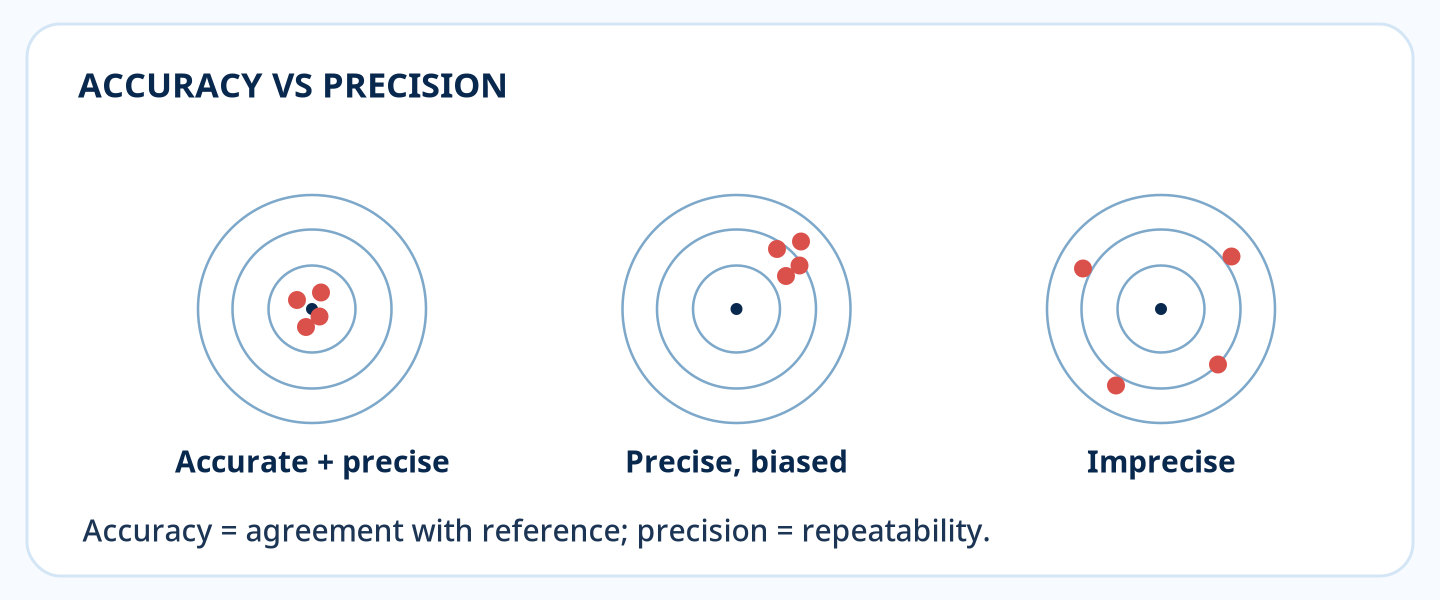
Separate accuracy and precision
Accuracy refers to proximity to a reference value; precision describes repeatability among measurements.
Analyze errors
Discuss systematic vs random effects, blank corrections, significant figures, and percent error without changing data to match expectations.
A measured density is 0.980 g/mL and the accepted value is 1.000 g/mL. Find percent error.
Percent error = |0.980 − 1.000| / 1.000 × 100% = 2.0%.
Common mistake
Do not confuse uncertainty with an excuse to edit observations. Always preserve raw readings and document any correction.
Practice with feedback
Select an answer to see a specific explanation. For more questions, open the General Chemistry Exam Center.
Loading local practice questions…
Keep learning
Try the full General Chemistry Exam Center for a mixed review, or select another topic in the Learning Center.
Open General Chemistry Exam Center →