

Nuclear Chemistry & Half-Life
Predict nuclear changes and calculate radioactive decay using half-life.
Learn the concept, then practice it
Predict nuclear changes and calculate radioactive decay using half-life. Start with the illustrated overview, follow the calculation, and try the questions.
N = N₀(1/2)^(t/t½)
Distinguish nuclear processes
Alpha decay emits a helium-4 nucleus; beta-minus decay converts a neutron to a proton; gamma emission changes energy but not atomic number.
Balance nuclear equations
Conserve mass number A and atomic number Z on each side of a nuclear equation.
Calculate decay
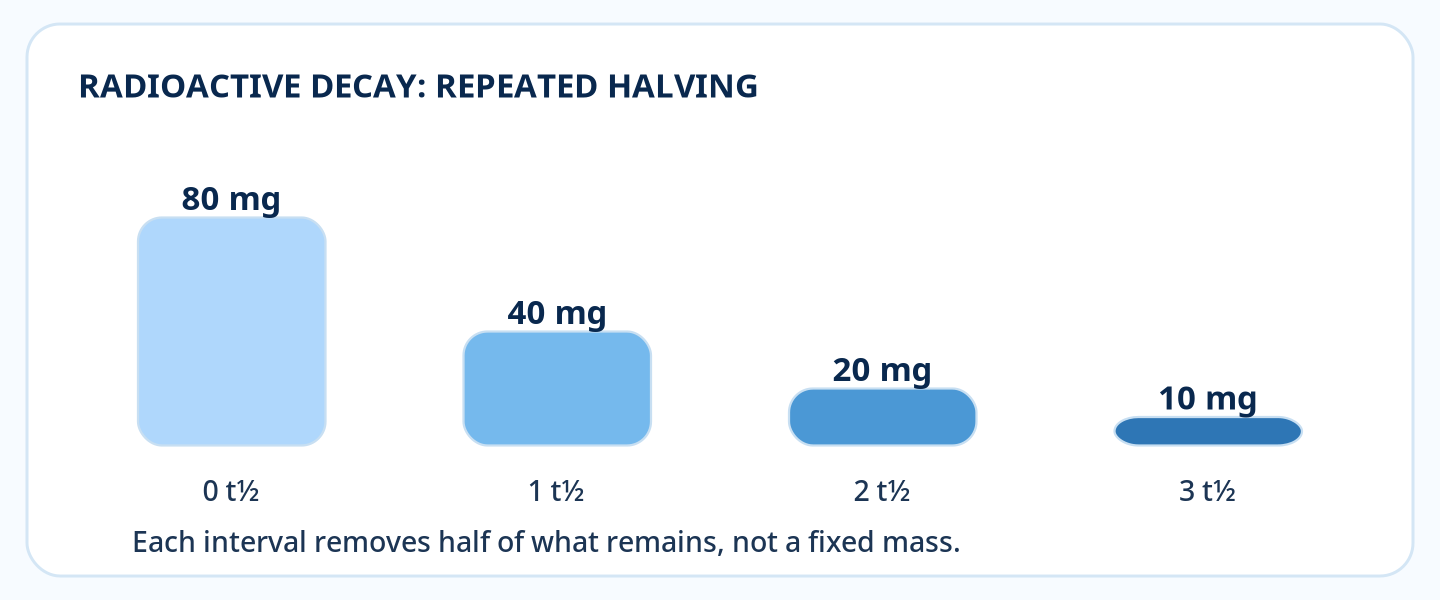
After each half-life, half of the remaining sample persists. The half-life of a nuclide is not changed by ordinary chemical reactions.
A radioactive sample starts at 80.0 mg. How much remains after three half-lives?
80.0 mg × (1/2)³ = 80.0/8 = 10.0 mg. This assumes a single nuclide with a constant half-life.
Common mistake
Half-life is the time to lose half of what remains, not the same fixed number of grams in every interval.
Practice with feedback
Select an answer to see a specific explanation. For more questions, open the General Chemistry Exam Center.
Loading local practice questions…
Loading educational calculator…
Keep learning
Try the full General Chemistry Exam Center for a mixed review, or select another topic in the Learning Center.
Open General Chemistry Exam Center →