

Redox Reactions & Galvanic Cells
Assign oxidation and reduction, trace electron flow and calculate cell potential.
Learn the concept, then practice it
Assign oxidation and reduction, trace electron flow and calculate cell potential. Start with the illustrated overview, follow the calculation, and try the questions.
E°cell = E°cathode(reduction) − E°anode(reduction)
Track electrons
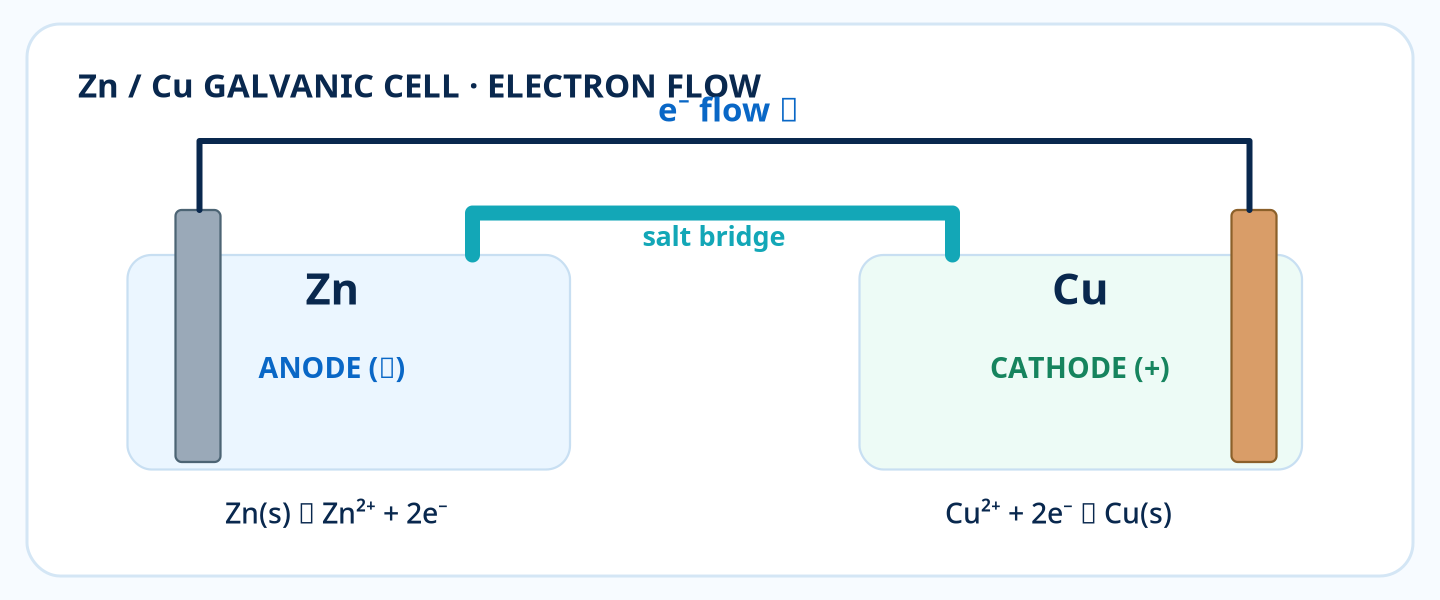
Oxidation is loss of electrons and reduction is gain. In a galvanic cell, oxidation occurs at the anode, reduction at the cathode.
Balance half-reactions
Electrons must cancel when half-reactions are added. Do not transfer electrons in the external circuit by moving ions through the wire.
Check cell potential
Standard reduction potentials are tabulated as reductions. Subtract the anode reduction potential from the cathode reduction potential.
For Zn(s) | Zn²⁺(aq) || Cu²⁺(aq) | Cu(s), calculate E°cell.
E°cathode = +0.34 V (Cu²⁺/Cu); E°anode(reduction) = −0.76 V (Zn²⁺/Zn). E°cell = +0.34 − (−0.76) = +1.10 V.
Common mistake
Electrons flow in the external wire from anode to cathode. In a galvanic cell, the anode is negative; sign conventions differ for electrolytic cells.
Practice with feedback
Select an answer to see a specific explanation. For more questions, open the General Chemistry Exam Center.
Loading local practice questions…
Keep learning
Try the full General Chemistry Exam Center for a mixed review, or select another topic in the Learning Center.
Open General Chemistry Exam Center →