
CHEMISTRY REFERENCE
Know the formula. Understand when to use it.
A carefully annotated reference with units, assumptions, common mistakes, and links to published lessons.
Mass to moles
n = m / M
Meaning and units: n in mol; m in g; M in g mol⁻¹.
Check: Use the molar mass of the specified substance, not a coefficient.
Read related lessonMoles to particles
N = n Nₐ
Meaning and units: Nₐ = 6.02214076 × 10²³ mol⁻¹ (exact).
Check: Count the specified atoms, molecules, ions, or formula units.
Read related lessonMolarity
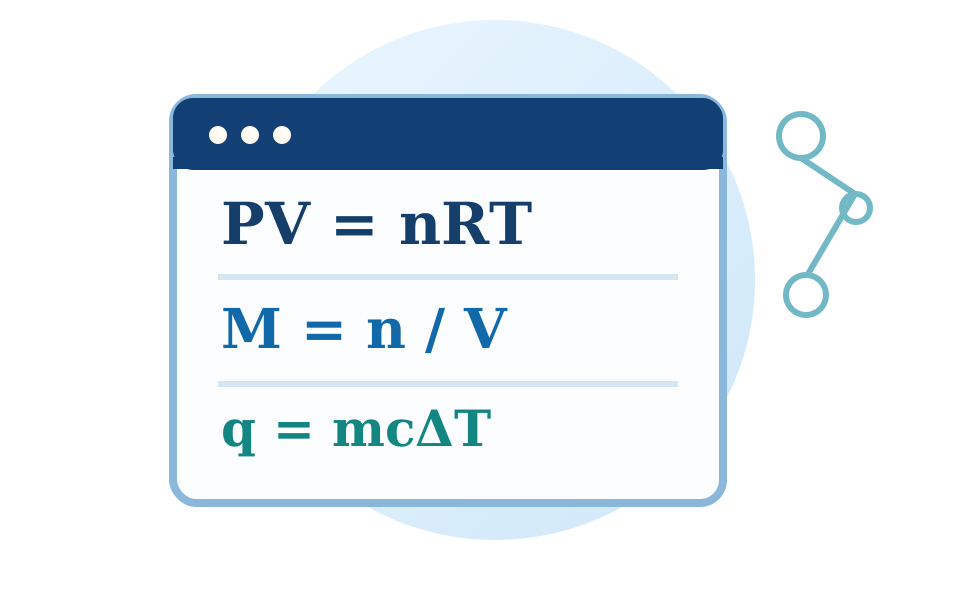
M = n / V
Meaning and units: M in mol L⁻¹; n in mol; V in L.
Check: Use solution volume, not solvent volume.
Read related lessonDilution
M₁V₁ = M₂V₂
Meaning and units: Applies when the solute amount is conserved.
Check: Added solvent changes concentration, not moles of solute.
Read related lessonDensity
ρ = m / V
Meaning and units: Use consistent mass and volume units.
Check: For displacement, subtract initial from final volume.
Read related lessonPercent yield
% yield = 100 × actual yield / theoretical yield
Meaning and units: Use the same mass or mole units for both yields.
Check: Calculate theoretical yield from the limiting reactant.
Read related lessonAbsolute percent error
% error = 100 × |measured − accepted| / |accepted|
Meaning and units: Reference value must be nonzero.
Check: Keep the signed error separately when direction matters.
Read related lessonIdeal gas law
PV = nRT
Meaning and units: Use an R value consistent with pressure and volume units; T in K.
Check: Do not insert temperature in °C.
Read related lessonBoyle’s law
P₁V₁ = P₂V₂
Meaning and units: Fixed n and T for ideal gases.
Check: State the fixed-temperature assumption.
Read related lessonCharles’s law
V₁/T₁ = V₂/T₂
Meaning and units: Fixed n and P; temperatures in K.
Check: Absolute temperature is required.
Read related lessonCalorimetry heat
q = mcΔT
Meaning and units: c = specific heat; ΔT = T_final − T_initial.
Check: Distinguish heat gained by solution from heat released by reaction.
Read related lessonReaction heat in calorimeter
q_rxn = −q_surroundings
Meaning and units: Only when additional heat exchanges are negligible or accounted for.
Check: An assumption, not a universal identity for every calorimeter.
Read related lessonpH
pH = −log₁₀(a_H⁺)
Meaning and units: Activity-based definition; [H⁺] approximation in dilute solutions.
Check: pH is not universally equal to −log concentration in nonideal media.
Read related lessonpOH
pOH = −log₁₀(a_OH⁻)
Meaning and units: At 25 °C in dilute aqueous solution, pH + pOH ≈ 14.00.
Check: The value 14.00 depends on temperature and conventions.
Read related lessonHenderson–Hasselbalch
pH ≈ pKₐ + log₁₀([A⁻]/[HA])
Meaning and units: Useful buffer approximation under appropriate conditions.
Check: Not reliable when the weak acid/base has been essentially consumed.
Read related lessonThin-layer chromatography Rf
R_f = distance of spot / distance of solvent front
Meaning and units: Measure both from the same baseline; 0 ≤ Rf ≤ 1 for normal TLC.
Check: A spot position alone does not establish compound identity.
Read related lessonBeer–Lambert law
A = εℓc
Meaning and units: A unitless; ℓ in cm; c consistent with ε.
Check: Requires an appropriate linear concentration range.
Read related lessonLinear calibration
y = mx + b; x = (y − b) / m
Meaning and units: For nonzero slope, within the validated calibration range.
Check: Avoid extrapolating far outside standards.
Read related lessonFirst-order half-life
t₁/₂ = ln(2)/k
Meaning and units: For a genuine first-order process; k in reciprocal time.
Check: Other reaction orders have different half-life relationships.
Read related lessonRadioactive decay
N = N₀(1/2)^(t/t₁/₂)
Meaning and units: Applies to populations with constant decay probability.
Check: Use the same units for t and t₁/₂.
Read related lessonGibbs free energy
ΔG = ΔH − TΔS
Meaning and units: At fixed T, with consistent energy units.
Check: Interpret spontaneous tendency under the stated conditions.
Read related lessonReaction quotient
Q = ∏ a_products^ν / ∏ a_reactants^ν
Meaning and units: Activities raised to stoichiometric coefficients; pure solids/liquids omitted.
Check: Use balanced stoichiometric coefficients.
Read related lessonStandard cell potential
E°cell = E°cathode − E°anode
Meaning and units: Values are reduction potentials.
Check: Do not multiply electrode potentials by coefficients.
Read related lessonDegree of unsaturation
DBE = (2C + 2 + N − H − X)/2
Meaning and units: Neutral closed-shell formulas of C,H,N and halogens; O,S ignored.
Check: Count halogens as H; check if formula assumptions apply.
Read related lessonFormal charge
FC = valence e⁻ − nonbonding e⁻ − ½(bonding e⁻)
Meaning and units: Bookkeeping for a specified Lewis structure.
Check: Sum of formal charges equals overall species charge.
Read related lessonIR wavenumber
ṽ = 1 / λ
Meaning and units: Use cm for λ to obtain cm⁻¹.
Check: A single IR band rarely proves compound identity.
Read related lessonGC uncorrected area fraction
area % = 100 × Aᵢ / ΣAⱼ
Meaning and units: Uncorrected detector-response fraction for integrated peaks.
Check: Not necessarily mass fraction, mole fraction or purity without response factors.
Read related lessonNo formulas matched
Try a shorter term or another category.
Formulas are teaching references; always check experimental conditions, units, and stated assumptions.