
Learning Center · All chemistry subjects
Find a lesson, follow its worked examples, test your understanding, and download a printable worksheet. Resources are organized by subject and type so students can move directly to the topic they need.
Find your next chemistry breakthrough
Find chemistry lessons, practice questions, exam preparation and worksheets in one place.
61 available resources
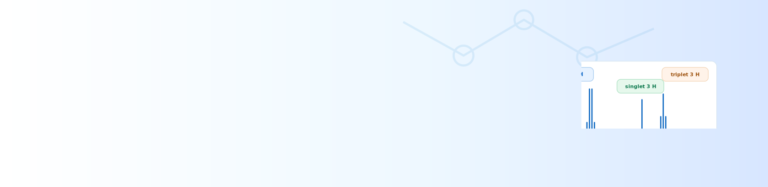
¹H NMR: Chemical Shift, Integration & Splitting
Interpret chemical shifts, integrals and simple n + 1 splitting using a real ethyl acetate example.
Open resource
Acid–Base Titrations & Equivalence
Calculate equivalence volumes and explain indicator and titration curves.
Open resource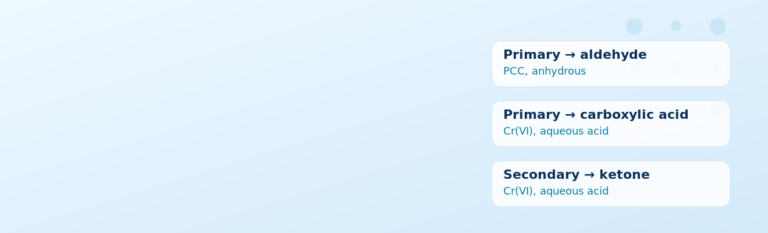
Alcohol Reactions: Oxidation, Dehydration & Substitution
Use alcohol structure and reaction conditions to predict carbonyls, alkenes, and substitution products.
Open resource
Aldehydes & Ketones: Understanding the Carbonyl
Recognize carbonyl groups, name simple compounds, and predict relative reactivity.
Open resource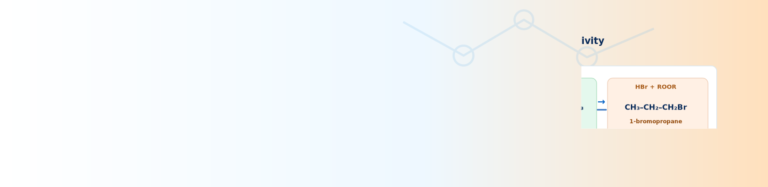
Alkene Addition Reactions: Predict the Product
Compare hydrohalogenation, hydration, bromination and hydroboration with predictable regiochemistry.
Open resource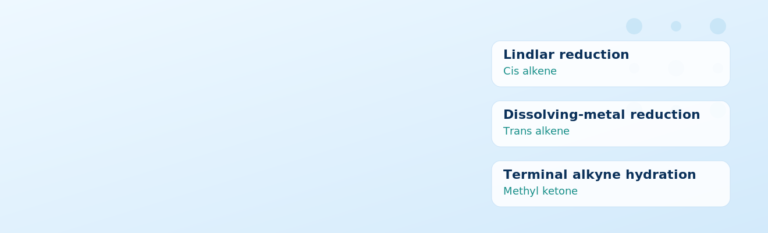
Alkyne Reactions & Selective Reduction
Differentiate cis and trans partial reductions and predict terminal-alkyne hydration products.
Open resource
Assigning R and S Configuration: A Visual Guide
Practice CIP priorities, viewpoint and the clockwise/counterclockwise rule for stereocenters.
Open resourceAtomic Structure, Isotopes & Atomic Mass
Connect protons, neutrons, electrons, isotopes and weighted-average atomic mass.
Open resource
Carbonyl Chemistry Exam Review
Differentiate addition, oxidation, reduction, esterification and acyl substitution.
Open resource
Carbonyl Chemistry Learning Center
Master aldehydes, ketones, nucleophilic addition and acyl derivatives through six complete lessons, curated reactions, and worked practice.
Open resource
Carboxylic Acids & Fischer Esterification
Understand acid structure, carboxylate stability, and equilibrium-driven ester synthesis.
Open resourceChemical Equilibrium, Q & K
Write equilibrium expressions and compare reaction quotient Q with K.
Open resourceChemistry Resource Explorer
Search and filter IntoChemistry lessons, worksheets, practice tools, and exam-prep resources.
Open resource
Chemistry Worksheets & Answer Keys
Practice one topic at a time. Download student worksheets and separate, worked instructor-style solutions.
Open resourceDimensional Analysis & Unit Conversions
Convert quantities by canceling units instead of memorizing isolated formulas.
Open resource
E2 in Cyclohexanes: Trans-Diaxial Requirement
Understand why ring conformations control E2 elimination and how to recognize a productive chair.
Open resourceElectron Configurations & Orbital Diagrams
Fill orbitals correctly and relate electron arrangement to the periodic table.
Open resource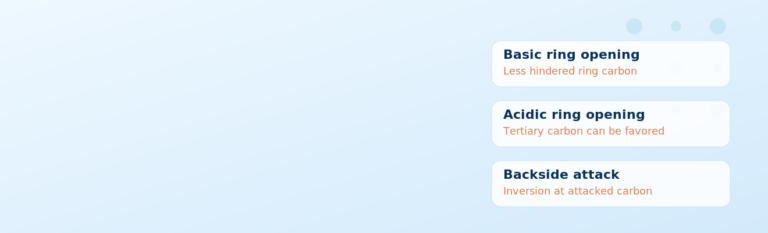
Epoxide Ring Opening: Acidic vs Basic Conditions
Predict which epoxide carbon is attacked and where the new C–Nu bond forms.
Open resource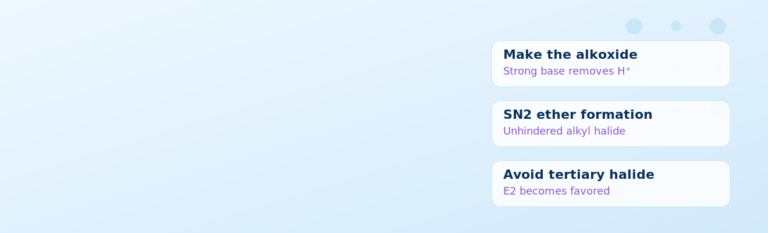
Ethers & Williamson Ether Synthesis
Learn why a primary electrophile and a strong alkoxide form an ether by an SN2 pathway.
Open resource
Gas Laws: Boyle, Charles, and the Ideal Gas Equation
Select a gas law, convert temperature to kelvin, and solve with correct units.
Open resourceGeneral Chemistry Exam Preparation Center
Fourteen illustrated lessons, a topic-filtered question bank, worked explanations, practice exams and printable classroom resources.
Open resourceGeneral Chemistry Formula Sheet
Search 14 topic-specific relationships and open the matching lesson for worked examples and important assumptions.
Open resourceGeneral Chemistry Worksheet Library
Fourteen topic-based, instructor-developed review sets with student PDFs, editable Word files and separate worked answer keys.
Open resource
Hemiacetals, Acetals & Protecting Groups
Learn why alcohol addition produces hemiacetals and how acidic conditions yield acetals.
Open resource
How to Balance Chemical Equations
Learn a repeatable method for balancing reactions without changing the chemical substances.
Open resource
How to Draw Lewis Structures
Count valence electrons, draw bonds, and check octets and formal charges.
Open resource
How to Write Ionic Compound Formulas
Use ion charges and the lowest whole-number ratio to write neutral ionic compounds with confidence.
Open resource
Imine & Enamine Formation
Connect the choice of amine to C=N formation or alpha-carbon unsaturation.
Open resourceIntermolecular Forces & Properties
Distinguish dispersion, dipole–dipole and hydrogen bonding and predict trends.
Open resource
IR Spectroscopy: Identify Functional Groups
Read wavenumber, bond vibrations, carbonyl and O–H bands; practice identifying functional groups.
Open resourceLaboratory Measurement, Precision & Error
Report measurements consistently, distinguish accuracy from precision and assess uncertainty.
Open resource
Learn Chemistry. Practice Chemistry. Master Chemistry.
Complete lessons, curated practice, chemistry diagrams, and printable resources—all organized by topic.
Open resource
Limiting Reactant Problems: Step-by-Step
Identify which reagent runs out first and calculate theoretical product amount.
Open resource
Molarity: Formula, Examples & Calculator
Understand concentration, solve molarity problems step by step, and check your calculations with a free tool.
Open resource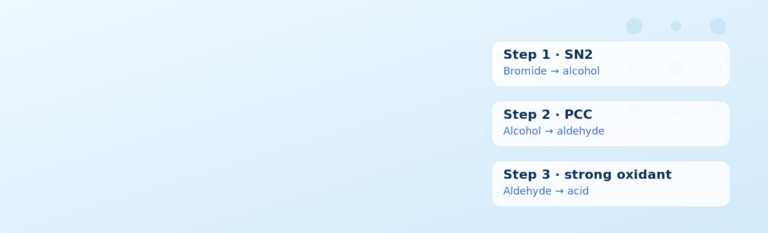
Multistep Organic Synthesis: Reaction Roadmaps
Learn to plan transformations backward from the target molecule and verify each step.
Open resource
Multistep Synthesis Exam Review
Plan reagents backward from a target and evaluate the route in the forward direction.
Open resourceNaming Molecular Compounds
Learn Greek prefixes, formula writing and clear distinctions from ionic naming.
Open resourceNet Ionic Equations & Precipitation
Identify dissolved spectators and write correctly balanced net ionic equations.
Open resourceNuclear Chemistry & Half-Life
Predict nuclear changes and calculate radioactive decay using half-life.
Open resource
Nucleophilic Acyl Substitution & Derivatives
Compare acid chlorides, anhydrides, esters and amides using the tetrahedral intermediate.
Open resource
Nucleophilic Addition to Carbonyls
Track nucleophile attack, the tetrahedral intermediate, and protonation or workup.
Open resource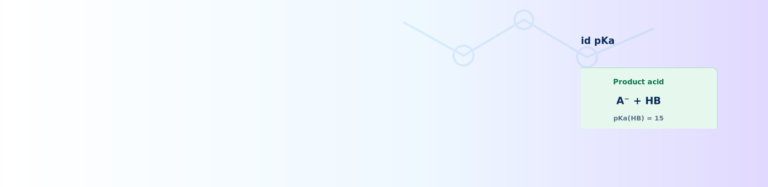
Organic Acid–Base Reactions: pKa & Equilibrium
Use conjugate acid strength and approximate pKa values to predict acid–base reaction direction.
Open resource
Organic Chemistry Exam Preparation Center
Review high-yield concepts, practice mechanism and spectroscopy questions, and take a cumulative mock exam—complete with explanations.
Open resource
Organic Chemistry Foundations Review
Review electron flow, acidity, resonance, valence, and reaction reasoning.
Open resource
Organic Chemistry Reaction Atlas
Find a reaction, understand the conditions, and practice predicting the outcome—without memorizing a disconnected reagent list.
Open resource
Periodic Trends: Atomic Radius, Ionization Energy, and Electronegativity
Understand why properties change across rows and down columns of the periodic table.
Open resourcepH, pOH & Strong Acids/Bases
Use logarithms to compare acidities and calculate pH for common strong electrolytes.
Open resource
Radical Reactions: Peroxides & Halogenation
Understand radical chains, HBr peroxide regioselectivity, and selectivity in radical halogenation.
Open resourceReaction Kinetics & Rate Laws
Analyze reaction-rate data, activation energy and the effect of catalysts.
Open resourceRedox Reactions & Galvanic Cells
Assign oxidation and reduction, trace electron flow and calculate cell potential.
Open resource
Significant Figures: Rules & Practice
Learn which digits count, how to round calculated results, and how to avoid the mistakes most students make.
Open resource
SN1 vs SN2 vs E1 vs E2: Choose the Pathway
Predict substitution or elimination by analyzing the substrate, reagent, solvent and reaction temperature together.
Open resource
SN2 Stereochemistry: Inversion Explained
Learn what inversion means, why R does not always become S, and how to redraw products correctly.
Open resource
Solution Dilution: C₁V₁ = C₂V₂ Explained
Calculate how much stock solution to transfer when preparing a new concentration.
Open resource
Spectroscopy Challenge Lab
Combine IR, ¹H NMR, integration, splitting, and TLC evidence to identify plausible structures.
Open resource
Stereochemistry Exam Review
Use CIP priorities, E/Z rules, and conformational reasoning to predict stereochemical outcomes.
Open resource
Stoichiometry: A Step-by-Step Guide
Use balanced equations to convert between grams, moles and product amounts with a repeatable problem-solving process.
Open resource
Substitution & Elimination Exam Review
Evaluate substrate class, nucleophile, solvent, and temperature before selecting a mechanism.
Open resourceThermochemistry & Calorimetry
Calculate heat transfer, interpret energy signs and solve calorimetry problems.
Open resource
Thin-Layer Chromatography: TLC & Rf Values
Understand normal-phase TLC, calculate Rf values and choose an effective solvent system.
Open resource
VSEPR Molecular Geometry and Bond Angles
Predict shapes using bonding regions, central lone pairs, and electron-group geometry.
Open resourceNo matching resources. Try a different keyword or filter.
Interactive chemistry tools
Available tools load from your existing IntoChemistry plugins. Each tool belongs on a lesson with instructions and examples.
[ic_sigfig_trainer][ic_stoich_trainer][ic_molarity_calculator][icv10_exam][icv11_practice][icv11_calculator][icv11_formula_sheet][ic_reaction_quiz][ic_reaction_reference][ic_balance_equations][ic_ionic_formula_trainer][ic_vsepr_practice][ic_limiting_reactant_practice][ic_gas_laws_practice][ic_periodic_trends_practice][ic_dilution_practice][icv6_practice][icv7_drill][icv8_drill][icv8_atlas][icv9_practice][icv9_carbonyl_atlas]